Small Bedroom Shelving Ideas That Save Space and Stay Practical
A small bedroom may not have enough floor space for another cabinet or nightstand, yet an unused section of wall, a narrow gap, or an awkward corner may still offer useful storage potential. The best small bedroom shelving ideas take advantage of those areas without making the room harder to move through or placing belongings where they are inconvenient to reach.
That does not mean every empty wall needs a shelf. A useful shelving solution should match what you actually need to store, fit the available space, and remain practical during everyday use.
Some bedrooms may benefit from one or two wall-mounted shelves. Others are better suited to a narrow freestanding unit, a compact bedside shelf, or low shelving that requires no wall installation.
This guide explains the main shelving options, where they tend to work, what to consider before installing or buying them, and how to avoid turning limited bedroom space into an overcrowded storage wall.
Quick Small Bedroom Shelving Plan
- Decide exactly what the shelf needs to hold before choosing a design.
- Check the wall and floor space you already have available.
- Measure width, depth, height, reachability, and nearby furniture clearance.
- Compare floating, corner, bedside, low, and freestanding shelving options.
- Use mounting hardware appropriate for the actual wall and shelf.
- Follow the manufacturer’s installation instructions and load limits.
- Keep doors, windows, vents, switches, and walking routes clear.
- If you rent, check lease or property-management restrictions before making permanent changes.
Table of Contents
Start With What Your Bedroom Shelves Need to Hold
Choose shelving around the belongings, not the other way around.
A shelf intended for two current books and reading glasses has very different requirements from one intended to hold several heavier books or storage containers. The amount of weight, the depth of the items, how often you use them, and where you need access should all influence the shelf you choose.
Possible bedroom shelf categories include:
- current books;
- bedtime essentials;
- lightweight accessories;
- small storage containers;
- restrained decorative objects;
- and occasional belongings.
Think about access frequency as well.
A bedside shelf should place daily essentials within comfortable reach. A higher shelf may be acceptable for an appropriately lightweight item you use occasionally.
Shelf depth matters because deeper is not automatically better. A shelf that projects too far into a narrow area may interfere with movement or make the room feel crowded.
Load capacity also matters. The amount a shelf can safely support depends on its construction, mounting system, wall conditions, and installation. Do not assume that two shelves of similar size have the same capacity.
Most importantly, avoid filling shelves simply because space is available. Storage should solve a problem rather than create another surface that gradually becomes overcrowded.
If you’re still deciding which belongings deserve convenient storage and how to organize limited space before adding shelves, our guide on how to organize small spaces offers a practical starting point.
Small Bedroom Shelving Ideas for Different Room Layouts
Different bedrooms need different shelving solutions. The useful choice is the one that fits your layout, belongings, and access needs.
Floating Shelves for Available Wall Space
Floating shelves can provide storage without using additional floor space. Among small bedroom shelving ideas, floating shelves are worth considering when suitable wall space is available but additional floor furniture would make the room crowded.
They may work well for:
- a few books;
- lightweight personal items;
- a small bedside setup;
- or restrained decorative belongings.
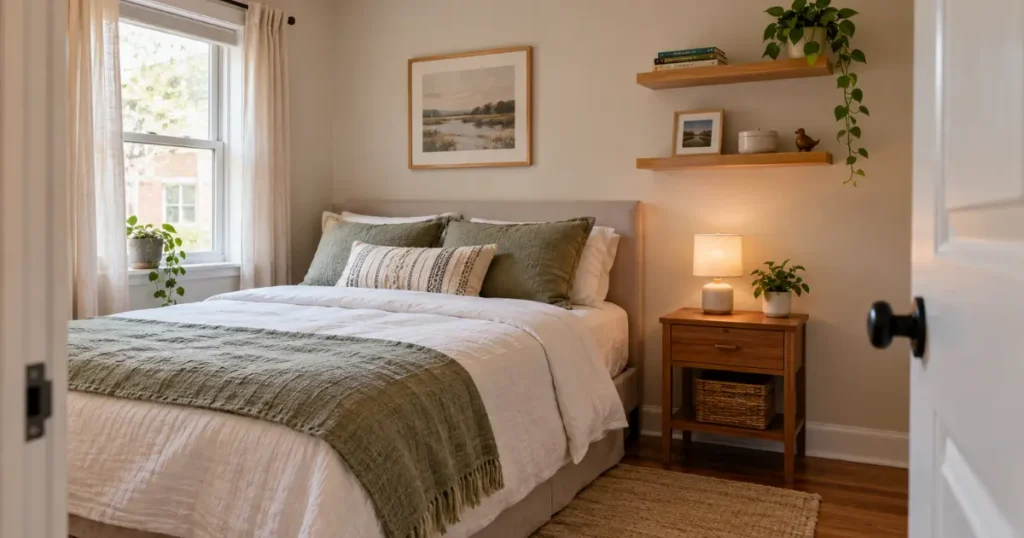
Their clean appearance can be useful in compact rooms, but the lack of visible brackets does not mean installation requirements are simple.
Check:
- how the shelf mounts;
- what type of wall it will be attached to;
- the manufacturer’s stated load limits;
- how far the shelf projects into the room;
- and whether you can comfortably reach its contents.
Avoid assuming a floating shelf is automatically suitable for a heavy row of books.
Capacity depends on the specific shelf, hardware, wall construction, and installation.
For a practical example, IKEA’s LACK wall shelf installation guidance illustrates why wall construction and appropriate mounting hardware matter. Its product instructions specify different conditions for different wall types, so always check the requirements for the exact shelving product you intend to install.
A floating shelf also needs an appropriate location. A shelf that projects into a tight walkway or sits where someone may bump into it is not a good use of wall space.
Corner Shelves for Suitable Unused Corners
A bedroom corner may seem like wasted space, but not every corner needs storage.
Corner shelves can be useful when the space is otherwise difficult to use and the shelves remain accessible.
They may work for:
- a few lightweight books;
- personal items;
- small containers;
- or occasionally used belongings.
Before choosing one, consider the actual depth.
A corner shelf that extends too far may interfere with the bed, dresser, or walking path.
Also consider how easy it will be to reach the back of the shelf. A deep corner solution may technically provide more surface area while making stored items inconvenient to retrieve.
Corners near doors require particular care. Do not add shelving where it restricts door movement or creates a protruding edge in a narrow passage.
Use corner shelving when the geometry genuinely helps the room—not simply because the corner is empty.
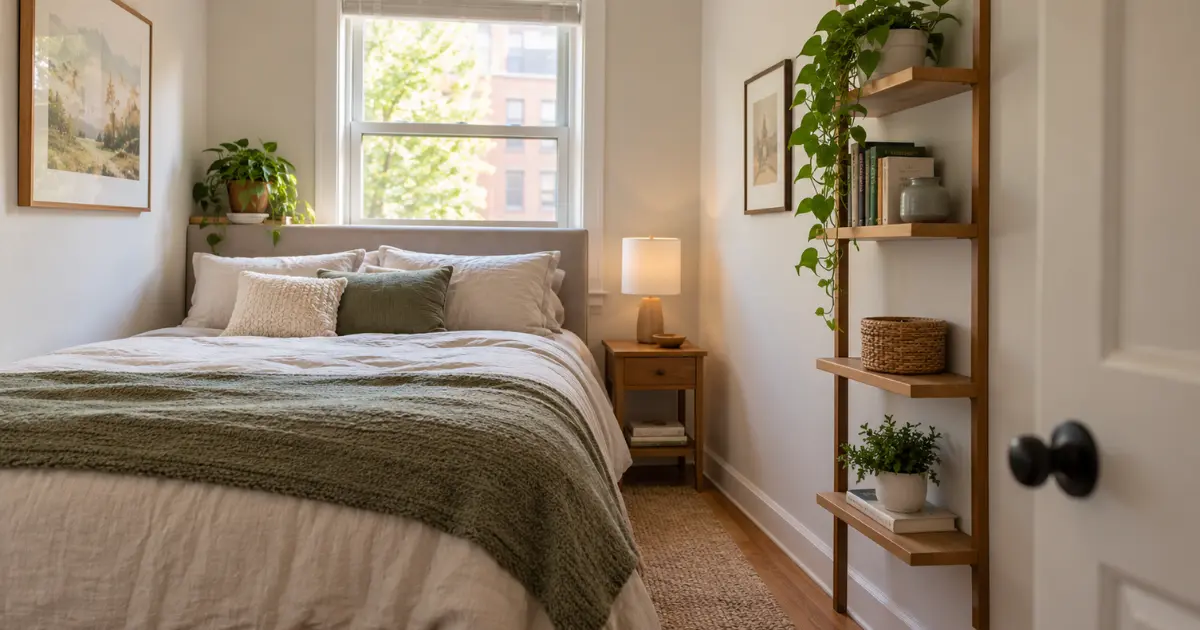
Narrow Freestanding Shelving Units
A slim freestanding shelving unit can provide several storage levels without covering a large amount of wall width.
It may be useful beside:
- a dresser;
- a desk;
- a section of open wall;
- or another furniture piece where the floor route remains clear.
Look at the complete dimensions rather than width alone.

A tall unit may be narrow from side to side but still too deep for the available floor space.
Consider:
- shelf depth;
- accessible shelf heights;
- the items you plan to store;
- furniture stability;
- nearby doors and drawers;
- and the room’s walking route.
Keep frequently used items at practical levels. Appropriately lightweight, occasional items can occupy less convenient shelves.
Tall freestanding furniture also introduces tip-over considerations. Follow manufacturer assembly and anchoring guidance where applicable instead of assuming a narrow unit is stable simply because it stands upright.
This is where shelving-specific planning differs from simply adding more vertical storage: the individual shelf depth, access, construction, and suitability for the stored items all matter.
Bedside Wall Shelves That Can Replace a Nightstand
In some bedrooms, there is not enough floor space for a conventional nightstand.
A modest wall-mounted bedside shelf may provide enough room for a few essentials while leaving the floor below clear.
A useful bedside shelf might hold:
- reading glasses;
- one current book;
- a phone;
- or another lightweight bedtime essential.
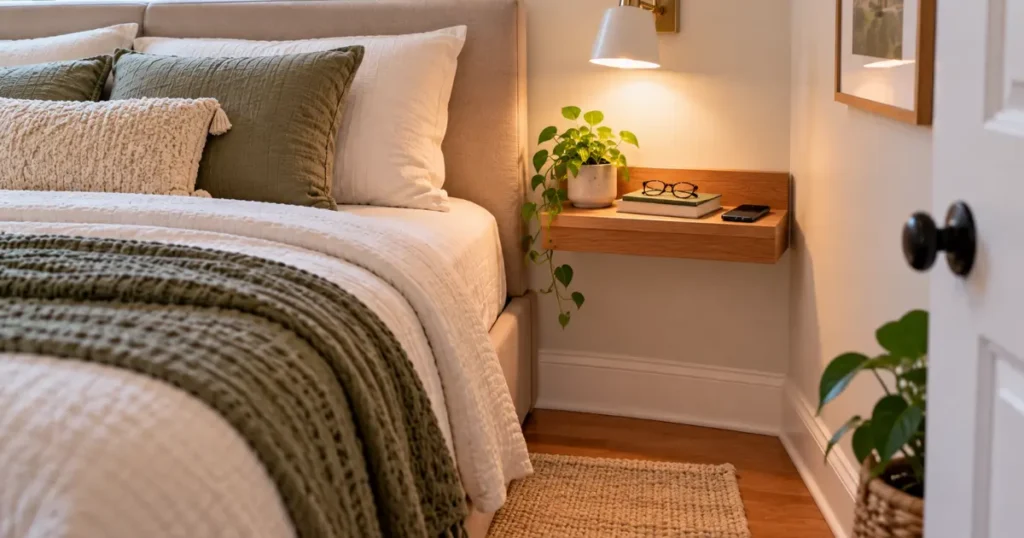
Keep the surface intentionally limited.
A bedside shelf is not a substitute for a large cabinet. If you need several drawers or substantial storage, another solution may be more appropriate.
Placement is especially important beside a bed.
The shelf should be reachable without awkward stretching, positioned so it does not create a bump hazard, and installed according to the wall and manufacturer requirements.
Avoid storing heavy, unstable, or breakable objects where they could fall toward the sleeping area.
For the right room and limited storage need, however, a compact bedside shelf can reduce the footprint of furniture without sacrificing a useful surface.
Shelves Above a Dresser or Other Low Furniture
Wall space above a dresser can sometimes provide additional storage without requiring another floor-standing piece.
This may work for a small number of appropriate belongings, particularly items that do not need constant access.
Before adding shelves, check:
- how high the dresser already is;
- whether you can comfortably reach the proposed shelf;
- whether objects could fall onto the dresser or someone standing nearby;
- the shelf’s load requirements;
- and whether the wall is appropriate for installation.
Do not place frequently used belongings so high that you need to stretch or climb to retrieve them.
Also avoid installing a deep shelf where it projects awkwardly above the dresser.
The area above furniture is only useful storage when the shelf remains accessible and appropriately positioned.
Low Shelving for Bedrooms With Limited Wall Space
Wall mounting is not practical in every bedroom.
A low shelving unit can provide an alternative when you have suitable floor space but cannot or do not want to mount shelves.
Low shelves may fit:
- beneath an appropriate window;
- along a short wall;
- near the foot of a bed;
- or beside another low furniture piece.
But placement needs careful thought.
Do not block vents, window operation, or necessary access.
Low furniture also uses floor space, so compare its footprint with what it actually holds.
A low bookcase that fits neatly along a wall may be practical. One that narrows the only walkway simply trades a storage problem for a movement problem.
Choosing bedroom storage also means balancing storage capacity with comfortable movement. For broader guidance on furniture placement, usable floor space, and everyday functionality, explore our Small Space Living guide.
Shelving Around Awkward Bedroom Features
Some bedrooms include narrow wall sections, shallow recesses, unusual corners, or other architectural areas that may accommodate a carefully selected shelf.
These spaces can be useful, but avoid forcing storage into every irregular area.
Do not place shelves where they interfere with:
- windows;
- vents;
- switches;
- outlets;
- bedroom or closet doors;
- or access to fixed equipment.
A small recess may work for a modest shelf if the dimensions suit the intended belongings.
A narrow wall between two features may accommodate one shallow shelf rather than an entire vertical arrangement.
The goal is to make an awkward space useful without turning it into an elaborate custom-carpentry project.
How to Choose Between Wall-Mounted and Freestanding Shelves
Both options can work in a small bedroom.
The better choice depends on your room, rental situation, belongings, and willingness to install something permanently.
Wall-mounted shelves can preserve floor space and may work well where useful wall area is available. Their limitations include installation requirements, wall suitability, fixed placement, and product-specific load limits.
Freestanding shelves are easier to reposition and may be more practical for renters. However, they consume floor space and can introduce stability concerns, particularly when they are tall or narrow.
Ask yourself:
- Do I have enough floor space for a unit?
- Is the wall suitable for mounting?
- Am I allowed to make wall alterations?
- How heavy are the belongings?
- Do I expect to move or rearrange the room?
- How frequently do I need access?
- Would the shelving interfere with other furniture?
Neither choice is automatically better.
A wall-mounted shelf can save floor space but be unsuitable for the wall or lease conditions. A freestanding unit may avoid drilling but take up too much of a narrow walkway.
Choose based on the actual constraints of the room.
If you live in a small apartment and shelving alone cannot meet your storage needs, explore our small apartment storage ideas for additional options, including under-bed storage, multifunctional furniture, and other space-saving solutions.
Where to Put Shelves in a Small Bedroom
Placement affects usefulness just as much as shelf design.
Beside the Bed
Bedside shelving should support the belongings you use while in bed.
Keep it within comfortable reach and avoid excessive depth.
Make sure its position does not interfere with getting into or out of bed.
If mounted, follow the product’s installation requirements and avoid unstable objects near the sleeping area.
Above Existing Furniture
The area above a dresser, desk, or other low furniture can sometimes provide shelving space.
The shelf should remain reachable, suit the wall, and leave enough clearance above the furniture.
Avoid adding a shelf simply because the wall looks empty.
Consider whether stored items can be retrieved comfortably and whether anything could fall onto someone using the furniture below.
In a Corner
Corner shelving can work where two walls meet and ordinary furniture would be inefficient.
Check whether the shelf interferes with a nearby door, bed, dresser, or walkway.
The location should provide genuine usable capacity rather than an awkward storage point.
Along a Narrow Wall
A shallow shelf can sometimes work along a narrow wall where deeper furniture would not.
Depth becomes especially important here.
Even a shelf that fits the wall width may project too far into the walking route.
Measure the wall and the route beside it before deciding.
How to Measure for Bedroom Shelves
Measure more than the empty wall.
Start with the usable wall width and height, but also consider what surrounds the proposed shelving location.
Check:
- available wall width;
- usable wall height;
- shelf depth;
- your comfortable reach;
- bed clearance;
- furniture clearance;
- door movement;
- nearby windows;
- vents;
- outlets;
- switches;
- baseboards or trim;
- and the relevant wall construction.
For freestanding units, measure the entire footprint.
For wall-mounted shelves, verify the manufacturer’s mounting conditions and hardware requirements.
A shelf can physically fit and still be impractical.
For example, a shelf may fit between a dresser and a doorway but project far enough to narrow the passage. Another shelf may fit above the bed but put stored belongings in an undesirable position over the sleeping area.
Avoid relying on universal shelf heights or depths.
The right dimensions depend on:
- what will be stored;
- how the shelf is constructed;
- where it will be installed;
- and how the surrounding bedroom functions.
Measure the location first, then compare shelving that genuinely fits those conditions.
Shelving Safety: Wall Support, Weight, and Furniture Stability
Shelving involves more than visual fit.
For wall-mounted shelves, use mounting hardware appropriate for the specific wall construction and follow the manufacturer’s installation instructions.
Different walls and products require different approaches.
Do not assume drywall alone is appropriate when the shelving manufacturer requires another type of anchoring or structural support.
Respect stated load limits.
A shelf intended for lightweight accessories should not automatically be treated as a book shelf.
The total load includes everything placed on it, so avoid gradual overloading as belongings accumulate.
For freestanding shelving:
- assemble the unit correctly;
- place it on an appropriate surface;
- avoid unstable loading;
- and follow manufacturer guidance regarding anchoring or tip-over prevention.
Tall furniture may require additional stability measures even when wall-mounted shelving itself is not being used.
For freestanding bookcases and other tip-over-prone furniture, the U.S. Consumer Product Safety Commission provides furniture anchoring and tip-over prevention guidance. This is particularly important in homes where children live or visit. Follow the furniture manufacturer’s instructions for appropriate anchoring.
Think about what happens if an object falls.
Avoid placing heavy or unstable belongings where they could fall onto the bed or into a walking route.
Shelving should also leave normal bedroom movement and escape routes unobstructed. Bedroom shelving should never obstruct doors or windows needed for emergency escape. The U.S. Fire Administration’s home fire escape planning guidance recommends keeping these exits clear so they remain usable during an emergency.
If you are uncertain whether a particular wall, installation method, or furniture setup is appropriate, professional assistance may be more sensible than improvising a mounting solution.
Renter-Friendly Shelving Ideas for Small Bedrooms
Renters often need storage without making unauthorized permanent changes. For renters exploring small bedroom shelving ideas, the best option depends on available floor space, property restrictions, and whether the furniture requires anchoring.
Freestanding shelving is one of the most flexible options.
A suitably sized bookcase or low shelving unit may be easier to relocate than permanently installed shelves, although some freestanding furniture still requires wall anchoring for safe use.
That does not mean every freestanding piece is automatically risk-free. Tall units may still require anchoring according to manufacturer guidance.
Other renter-conscious possibilities include:
- compact low shelving;
- furniture with existing shelf space;
- landlord-approved mounted shelves;
- or appropriate removable products intended for lightweight items.
Be cautious with claims that something is “damage-free.”
Adhesive products behave differently depending on:
- wall finish;
- paint condition;
- surface material;
- installation;
- removal method;
- and load.
Follow the product instructions and do not exceed its stated limits.
Also check your lease or property-management rules before drilling or mounting items.
A shelving idea is only renter-friendly if it is compatible with both the property requirements and safe installation.
What to Store on Small Bedroom Shelves
Shelf contents should match the shelf’s location and capacity.
Practical possibilities include:
- current books;
- bedside essentials;
- lightweight accessories;
- small containers;
- restrained personal items;
- and occasional belongings.
Frequently used items generally belong where you can reach them comfortably.
Higher shelves are usually more appropriate for suitably lightweight belongings that you do not use every day.
Avoid putting heavy or unstable objects in locations where dropping them could create a hazard.
Do not let a shelf become so full that retrieving one item requires moving everything else.
Visual crowding matters too.
In a very small bedroom, a wall covered from edge to edge with belongings may make the room feel busier even if everything technically fits.
A shelf does not need to be full to be useful.
Small Bedroom Shelving Mistakes to Avoid
Several shelving mistakes can reduce rather than improve bedroom usability.
- Choosing shelves without measuring. Wall width alone does not tell you whether the shelf depth or placement will work.
- Using shelves that project too far. Excessive depth can narrow walking routes or interfere with furniture.
- Overloading wall-mounted shelves. Follow manufacturer load guidance and installation requirements.
- Using unsuitable mounting hardware. The mounting method needs to match both the shelf and wall conditions.
- Blocking doors, windows, or other fixed features. Storage should not interfere with basic room operation.
- Placing everyday items too high. Convenient storage should actually be convenient to reach.
- Ignoring freestanding-furniture stability. Tall or narrow shelving may need appropriate anchoring.
- Adding too many shelves because wall space exists. More shelf area is not always more useful storage.
How to Choose the Right Shelving Solution for Your Bedroom
Use the room’s main constraint to narrow your options. The most practical small bedroom shelving ideas solve a specific storage problem while preserving safe access to the bed, closet, and walking route.
If You Have Available Wall Space but Little Floor Space
A wall-mounted shelf may be worth considering.
Decide what it needs to hold, then choose a shelf designed for that use.
Confirm wall suitability, required hardware, shelf depth, placement, and load limits before installation.
If You Cannot Mount Shelves
Look at freestanding alternatives that fit the floor space you actually have.
A narrow bookcase or low shelving unit may work, provided it does not block the walking route.
Stability still matters, particularly for tall furniture.
If You Need Bedside Storage
First determine what you really need beside the bed.
If it is only a phone, glasses, and current book, a modest bedside shelf may be enough.
If you need drawers, enclosed storage, medication storage, or a larger surface, a compact nightstand may be more practical.
Do not choose a wall shelf simply to eliminate furniture if it does not meet your real needs.
If you need substantially more bedroom storage than a compact bedside shelf can provide, consider whether furniture with integrated storage would be more practical. Our guide to storage beds for small bedrooms explains how to evaluate built-in drawers and lift-up compartments while accounting for floor space and access requirements.
If You Have an Awkward Corner
Measure the corner and consider whether a corner shelf would provide accessible storage.
If the shelf will be difficult to reach or interfere with nearby furniture, leaving the corner open may be the better choice.
If You Need to Store Heavy Items
Do not select a shelf based on appearance alone.
Use a product designed for the intended load, follow manufacturer installation requirements, and make sure the supporting wall or furniture arrangement is appropriate.
When the weight is substantial or the installation is uncertain, a sturdy freestanding solution or professional installation may be more suitable than improvising a wall-mounted setup.
How to Keep Bedroom Shelving Useful Over Time
A shelf that works well when first installed can gradually become overloaded.
Periodically review what it is holding.
Remove containers or objects that no longer need the space.
Watch for shelves that have become difficult to access because too many items have accumulated.
For freestanding shelving, make sure the unit remains stable and has not been repositioned somewhere less suitable.
For mounted shelving, follow the manufacturer’s guidance if you notice loose fittings, movement, or damage. Avoid unsupported repairs or modifications to structural hardware.
Also reconsider shelving when the bedroom layout changes.
Moving a bed, dresser, or desk may change:
- accessibility;
- walking clearance;
- the usefulness of a shelf;
- or whether stored items remain safely positioned.
Shelving should continue to solve the original storage problem rather than becoming permanent simply because it has always been there.
Frequently Asked Questions
What shelves work best in a small bedroom?
It depends on the room and what you need to store.
Floating shelves can preserve floor space where suitable wall mounting is possible. Narrow freestanding shelves can provide more capacity without permanent installation. Bedside or corner shelves may solve smaller, location-specific problems.
Choose based on dimensions, access, stored-item weight, and installation requirements.
Are floating shelves good for small bedrooms?
They can be useful because they provide storage without taking up floor space.
They work best when the wall is suitable, the shelf can be installed correctly, and the intended belongings fall within the product’s limits.
Avoid treating all floating shelves as suitable for heavy objects.
Where should shelves go in a small bedroom?
Useful locations may include an appropriate wall beside the bed, above suitable low furniture, in an accessible corner, or along a narrow wall where shelf depth does not interfere with movement.
The best location depends on room layout and what needs to be stored.
Can renters install bedroom shelves without drilling?
Sometimes, but it depends on the lease, wall surface, shelf, and mounting system.
Freestanding shelves may be simpler for renters.
Some removable products are intended for lightweight use, but follow their instructions and do not assume removal will always be damage-free.
How deep should bedroom shelves be?
There is no single ideal depth.
The right depth depends on what you intend to store, how much the shelf can project into the room, the product design, and the surrounding furniture.
Measure both the intended items and the available space before choosing.
Is a narrow bookcase better than wall shelves?
A narrow bookcase may provide more storage and require less wall installation, but it uses floor space and may need anchoring for stability.
Wall shelves can preserve floor area but require suitable walls and installation.
The better option depends on your room layout, storage needs, rental restrictions, and the belongings being stored.
Final Thoughts: Choose Shelving That Fits Your Room
The most useful small bedroom shelving ideas are not the ones that add the greatest number of shelves. They are the ones that provide the right amount of storage without compromising access, movement, safety, or everyday comfort.
Start with what you need to store. Then measure the available wall or floor space, consider how often you need access, and compare shelf types that genuinely suit the location.
Pay particular attention to installation requirements, load guidance, furniture stability, and nearby doors or walkways.
Your next step is simple: choose one specific shelving problem in the bedroom, measure the available space carefully, and evaluate only the options that solve that need without creating a new one.