
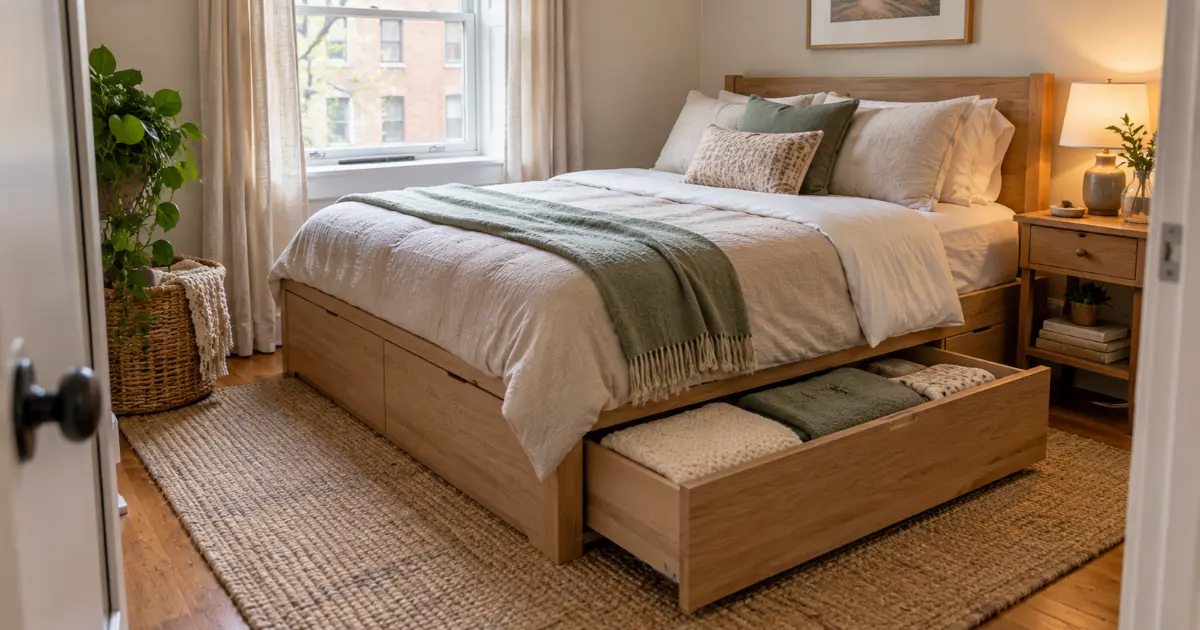
Storage Beds for Small Bedrooms: How to Choose the Right One
When the bed already occupies much of a compact bedroom, adding another dresser or storage cabinet may not be practical. That is why storage beds for small bedrooms can be appealing: they use space within the bed’s footprint to hold belongings that would otherwise need somewhere else to live.
But built-in storage does not automatically make a bed a good small-space choice. Drawers need room to open. Lift-up platforms need to be comfortable for the intended user to operate. The bed frame itself may be larger than the mattress, and a design that looks efficient online may interfere with a closet, dresser, doorway, or walking route once it is in the room.
This guide compares the main storage-bed configurations, explains their access requirements and trade-offs, and helps you determine whether a storage bed—or a conventional bed with removable containers—makes more sense for your bedroom.
Quick Storage Bed Buying Checklist
- Measure the entire external bed frame, not just the mattress size.
- Check how much usable access space exists beside and at the foot of the bed.
- Decide whether drawers or lift-up access better fits your room layout.
- Identify exactly what you intend to store before comparing bed designs.
- Verify mattress-size, thickness, and weight requirements for the specific frame.
- Review assembly, stability, mechanism, and manufacturer safety instructions.
- Compare usable internal storage with the cost and overall size of the bed.
- Keep a conventional bed in consideration if built-in storage would be awkward to access.
Table of Contents
Are Storage Beds a Good Idea for Small Bedrooms?
They can be, but only when the built-in storage is genuinely usable.
A storage bed can make sense if it allows you to reduce or avoid another piece of storage furniture. For example, if the bed can comfortably hold spare bedding and seasonal textiles that would otherwise require a separate cabinet, the integrated capacity may help preserve floor space elsewhere.
A storage bed is one example of choosing furniture that serves more than one purpose. For broader guidance on balancing furniture size, storage, movement, and everyday comfort, see our Small Space Living guide.
Potential advantages include:
- storage within the bed’s existing footprint;
- fewer separate furniture pieces when the capacity is sufficient;
- convenient containment for appropriate belongings;
- and better use of the area beneath the mattress.
There are trade-offs, too.
Storage-bed frames may be bulkier than simple bed frames. Drawer versions require surrounding floor clearance. Lift-up beds introduce moving hardware and may be heavier or more complicated to assemble. Some designs can also be more difficult to move when you rearrange the room or change homes.
Cost can be another consideration. Built-in storage adds construction and hardware, but paying more is not necessarily worthwhile if you already have adequate dresser, closet, or under-bed storage.
The key question is not, “Does this bed have storage?”
It is:
Can I comfortably use that storage in my actual bedroom?
Types of Storage Beds for Small Bedrooms
Storage beds are not one single design. Their usefulness depends heavily on how the compartment opens and where access is required.
Beds With Built-In Side Drawers
A bed with side drawers stores belongings in drawers integrated into the base or frame.
The main advantage is familiar access. You pull out a drawer much as you would a dresser drawer, and the contents can often remain separated into manageable sections.
Side drawers can work well when:
- there is adequate clear floor space beside the bed;
- you want fairly direct access to stored belongings;
- and nearby furniture will not interfere with the drawer movement.
The limitation is obvious in a tight layout.
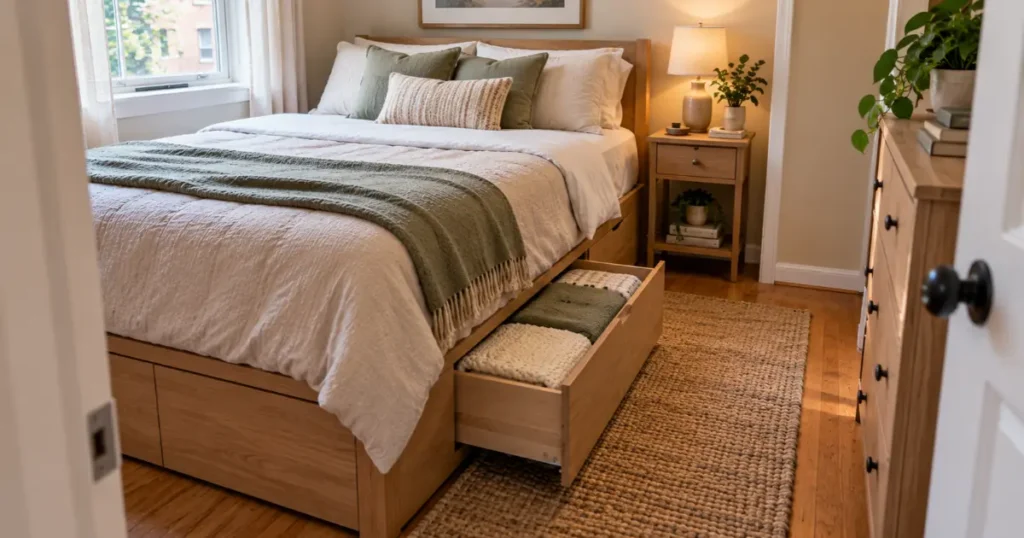
If one side of the bed sits close to a wall, dresser, or nightstand, drawers on that side may be difficult—or impossible—to open fully.
Even when a drawer technically opens, you still need enough room to stand, bend, and retrieve items comfortably.
Before choosing this configuration, look at both sides of the bed. Storage that can only be used from one side may still work, but you should evaluate the real usable capacity rather than the advertised number of drawers.
Lift-Up Storage Beds
A lift-up storage bed uses a mattress-support platform that raises to expose a larger compartment beneath the mattress.
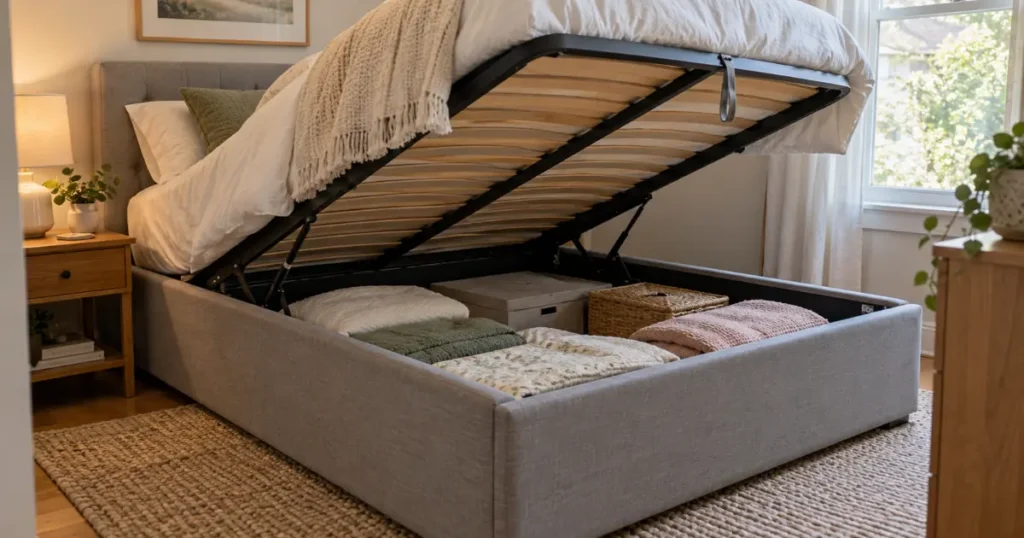
Many designs use some form of assisted lifting hardware. The exact mechanism, operating requirements, and mattress compatibility vary by product, so manufacturer specifications matter.
Lift-up storage may be useful where side-drawer clearance is limited because you do not need to pull large drawers into the room.
It can also provide a comparatively open storage compartment for belongings such as:
- spare bedding;
- seasonal textiles;
- occasional clothing;
- or other suitable low-frequency items.
However, access works differently from drawers.
You generally need to lift the platform before reaching the contents. Mattress weight, mattress thickness, frame design, and the lifting mechanism may affect how practical that is.
Do not assume a lift-up bed will feel effortless simply because the mechanism is assisted.
For someone who expects to access the compartment frequently, the lifting process deserves particular attention before purchase.
Beds With Foot-End Storage Drawers
Some frames use drawers that open from the foot of the bed.
This can be helpful when side clearance is restricted but there is usable open space beyond the footboard.
The arrangement may suit a bedroom where:
- the long sides of the bed are close to walls;
- the foot of the bed faces an open area;
- and no dresser, bench, door, or other furniture blocks the drawer path.
The same rule applies as with side drawers: measure the access area, not just the footprint of the closed bed.
A foot-end drawer that opens into a narrow passage may technically function but still be inconvenient in daily use.
Platform Beds With Storage Compartments
Some platform beds use cubbies, shelves, or enclosed compartments rather than traditional drawers.
These can provide accessible storage for smaller categories, but the design needs careful evaluation.
Open cubbies may make belongings easy to reach, but they also leave contents visible and more exposed to dust.
Closed compartments may look calmer but could require bending or reaching into a low space.
In a small bedroom, open compartments can also add visual activity to an already busy room. If every side of the bed displays books, bins, and accessories, the frame may feel heavier than a simpler storage design.
Beds With a Combination of Storage Features
Some storage beds combine multiple elements, such as drawers plus shelving or several types of compartments.
More storage features do not automatically make a bed better for a compact room.
Ask whether you will actually use each feature.
A headboard shelf may be useful if it replaces a bedside surface. Extra side cubbies may be less valuable if they require access from a side positioned against a wall.
If your main need is a convenient place for bedtime essentials rather than substantial hidden storage, consider our small bedroom shelving ideas. The guide explores compact bedside shelves and other space-saving options that may be more suitable than purchasing a storage bed with additional compartments.
Compare practical usefulness rather than counting compartments.
Drawer Storage vs. Lift-Up Storage: Which Is Better?
Neither design is universally better. The right choice depends on room clearance, what you plan to store, and how often you need access.
| Feature | Drawer storage | Lift-up storage |
|---|---|---|
| Access method | Pull individual drawers outward | Raise the mattress platform |
| Side clearance | Often requires usable drawer-opening space | May reduce dependence on side clearance |
| Frequency of access | Often convenient for more regular access | Often better suited to less-frequent access |
| Storage layout | Separate drawer compartments | Usually one larger compartment or fewer broad sections |
| Ease of use | Familiar drawer operation, but requires bending and clear floor space | Requires lifting the platform; practicality varies by mechanism and mattress |
| Mattress considerations | Usually less directly tied to drawer operation | Mattress dimensions, thickness, and weight may affect compatibility and use |
| Common limitations | Drawers can be blocked by walls or furniture | Lift mechanism and platform access may not suit every user |
The table highlights the basic trade-off, but the room layout remains decisive.
A bed with drawers may be convenient in a room with open space along one side. The same bed could be frustrating if pushed near a wall.
A lift-up model may eliminate that drawer-opening problem, but the user still has to access and operate the lifting platform safely and comfortably.
Think about retrieval frequency too.
If you expect to reach for an item every day, a compartment that requires lifting the mattress platform each time may be less convenient than a drawer. If you are storing spare comforters used only occasionally, lift-up access may be completely reasonable.
For a quick starting point, consider drawer storage when you have enough side clearance and want convenient access to separate compartments. Consider lift-up storage when side clearance is restricted and you mainly need space for occasional belongings, provided the mechanism and mattress are suitable. If neither option offers comfortable access, a conventional bed with removable under-bed containers may be the more practical choice.
How to Measure Your Bedroom Before Buying a Storage Bed
Measurement is one of the most important parts of the buying process.
Do not begin with the mattress alone.
Measure the Bed Frame, Not Just the Mattress
A nominal full-size or queen-size mattress does not tell you the bed’s total footprint.
Headboards, footboards, rails, upholstered edges, shelves, drawers, and decorative framing can increase the external dimensions.
Use the manufacturer’s full assembled dimensions when evaluating fit.
Then compare those measurements with the actual intended bed location.
Check Drawer-Opening Clearance
For a bed with drawers, determine how far each drawer extends when fully open.
Then check whether that space overlaps with:
- a dresser;
- nightstand;
- wall;
- closet door;
- bedroom door;
- radiator or other fixed feature;
- or the main walking route.
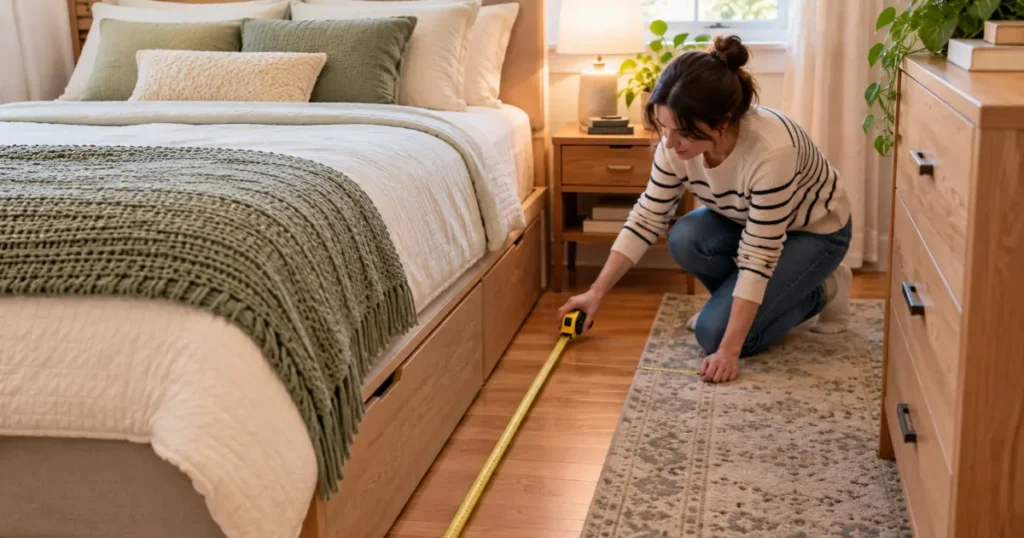
Also consider the space needed for a person to stand beside the open drawer and access the contents.
Do not rely only on whether the drawer can physically move.
Usable access matters.
Check Access Around the Bed
Look at how the storage bed will interact with everything nearby.
Can you still:
- reach both sides of the bed where needed;
- open the closet;
- open dresser drawers;
- enter and leave the bedroom comfortably;
- clean around the bed;
- and use nearby furniture?
A bed with excellent storage capacity can still be the wrong choice if it makes the rest of the room awkward.
Consider Headboard and Footboard Dimensions
A deep headboard can move the mattress farther into the room.
A substantial footboard can reduce open space at the foot of the bed.
These design details may matter in a bedroom where every piece of furniture is already closely spaced.
Look at the full geometry of the frame rather than treating the storage mechanism as the only concern.
Check Delivery and Assembly Access
The bed also has to reach the bedroom.
Before ordering, consider:
- entrance doors;
- hallways;
- stairways;
- elevators where relevant;
- tight corners;
- and whether large components can be carried into the room.
Some beds are assembled from relatively manageable sections. Others may include large or heavy pieces.
Check the seller’s and manufacturer’s delivery and assembly information rather than assuming the frame will fit through the home simply because its final dimensions fit the bedroom.
For a real-world example, the IKEA MALM storage-bed specifications state a maximum mattress weight for that particular lift-up model and warn about the consequences of exceeding it. Other storage beds may have different requirements, so always check the exact frame you are considering.
What Should You Store in a Storage Bed?
Built-in bed storage usually makes the most sense for belongings that benefit from being contained but do not need constant access.
Depending on the design and manufacturer guidance, suitable categories might include:
- spare sheets;
- extra blankets;
- seasonal textiles;
- occasional accessories;
- suitable off-season clothing;
- or lightweight belongings used periodically.
Frequently used items may be better placed somewhere easier to reach.
For example, if you wear the same clothing category every morning, a dresser drawer may be more convenient than lifting a mattress platform.
Keep moving mechanisms in mind as well.
Do not place belongings where they could interfere with drawer travel, hinges, lift components, or other hardware.
Follow the manufacturer’s storage and weight guidance for the specific bed rather than assuming every compartment can hold any household item.
PS-37 is about choosing the furniture. Detailed systems for clothing storage ideas for small bedrooms belong in the clothing-specific guide rather than being duplicated here.
Storage Beds for Small Bedrooms With Very Limited Side Clearance
Side clearance can determine whether a storage-bed design is practical.
If the bed sits close to a wall, built-in side drawers on that side may provide little real benefit.
In that situation, consider the access pattern rather than simply searching for the bed with the most compartments.
Questions to ask include:
- Can any side drawers open fully?
- Is there more usable space at the foot of the bed?
- Would foot-end storage work better?
- Is a lift-up mechanism compatible with the intended user and mattress?
- Will the bed still leave practical access to the closet and bedroom door?
A lift-up design may be worth considering because it does not rely on large drawers extending into the room.
But it is not automatically the answer.
The platform still needs to operate according to the manufacturer’s requirements, and the user must be able to access the compartment comfortably.
In some very narrow bedrooms, a simple bed frame with removable low-profile containers may actually be more flexible than a large integrated storage frame.
What to Look for Before Buying a Storage Bed
A storage bed is a substantial furniture purchase. Look beyond the photos and compare the features that affect real use.
Frame Construction and Stability
Review what the frame is made from, how it is assembled, and what the manufacturer requires for stable use.
A heavier frame is not automatically better, and a lighter frame is not automatically less suitable.
What matters is appropriate construction for the design.
Follow manufacturer instructions for assembly, hardware, placement, and any required safety measures.
Drawer and Lift Mechanism Quality
Storage beds rely on moving components.
For drawer beds, examine available information about:
- drawer runners or slides;
- drawer dimensions;
- how far the drawers extend;
- and whether hardware is replaceable or serviceable.
For lift-up beds, review:
- the type of assistance mechanism;
- opening method;
- recommended mattress parameters;
- and operating instructions.
Do not assume reliability from appearance alone.
Mattress Compatibility
This is especially important for lift-up designs.
A mattress that is too heavy, thick, or otherwise incompatible with the frame may affect operation.
The exact limits vary by model.
Before buying, verify:
- compatible mattress size;
- any specified thickness range;
- any relevant mattress-weight guidance;
- and whether the bed requires a particular support setup.
Do not substitute a general rule for the manufacturer’s specifications.
For a real-world example, the IKEA MALM storage-bed specifications state a maximum mattress weight for that particular lift-up model and warn about the consequences of exceeding it. Other storage beds may have different requirements, so always check the exact frame you are considering.
Usable Storage Capacity
A bed may look large from the outside while providing less practical internal storage than expected.
Check the actual storage dimensions where available.
For drawers, look at internal depth, width, and usable height.
For lift-up beds, examine the shape of the compartment and whether structural components divide the space.
Also think about what you plan to store.
A compartment may offer considerable volume but still be poorly suited to the shape or frequency-of-use needs of your belongings.
Ease of Cleaning and Maintenance
Built-in storage can change how easy the bed is to clean around and beneath.
Ask whether:
- drawers can be removed if necessary;
- the interior compartment is accessible for cleaning;
- dust can collect in open storage areas;
- and moving hardware can be inspected when required.
A storage bed should not make routine maintenance unnecessarily difficult.
Assembly, Delivery, and Moving
Storage beds can contain more components than a simple frame.
That can affect:
- assembly time;
- total furniture weight;
- moving difficulty;
- and future disassembly.
If you move frequently, consider whether the bed can be realistically taken apart and reassembled.
Also check whether professional assembly is offered or required by the seller, and what that service actually includes.
Warranty and Return Conditions
Before ordering, review:
- what parts of the frame or mechanism are covered;
- how long coverage lasts;
- exclusions;
- return conditions;
- return shipping or pickup terms;
- restocking charges where applicable;
- and what happens if the assembled bed does not fit the room.
A generous-looking storage design is less reassuring if returning or servicing it would be unusually difficult.
When a Storage Bed May Not Be Worth It
A storage bed is not the default solution for every compact bedroom.
It may be a poor fit when:
- side drawers cannot be opened comfortably;
- the lift mechanism does not suit the intended user;
- the outer bed frame is too bulky for the room;
- you already have enough useful storage elsewhere;
- the additional cost does not solve a meaningful problem;
- you move frequently and prefer lighter, simpler furniture;
- or removable under-bed containers would meet the same need more flexibly.
An ordinary bed can sometimes be the more practical small-space option.
Separate containers may be easier to replace, rearrange, clean, or take with you when moving.
If a storage bed does not suit your bedroom layout or budget, explore our small apartment storage ideas for other practical options, including under-bed containers, vertical shelving, and multifunctional furniture that can provide storage without requiring a specialized bed frame.
The better choice is the one that provides usable, not merely advertised, storage.
Storage Bed Buying Mistakes to Avoid
Several purchasing mistakes can make an otherwise attractive bed frustrating in a small room.
- Buying based only on mattress size. The frame may extend significantly beyond the mattress footprint.
- Forgetting drawer-opening clearance. Closed dimensions do not tell you how much working space drawers require.
- Assuming lift-up mechanisms are effortless. Operation varies by frame, mechanism, and mattress.
- Ignoring mattress compatibility. Lift-up systems may have specific requirements.
- Overlooking delivery and assembly. A bed that fits the room still has to reach it and be assembled there.
- Comparing only total bed size. Two similar-size frames may provide very different usable storage.
- Ignoring maintenance and repair considerations. Moving hardware and integrated drawers may eventually need adjustment or service.
- Choosing maximum capacity instead of convenient access. Storage you avoid using because it is difficult to reach provides little practical benefit.
How to Choose the Right Storage Bed for Your Room
Start with your bedroom layout rather than with a particular bed style.
If You Have Enough Space Beside the Bed
Side drawers may offer straightforward access.
They can be especially practical when you want separated compartments and expect to retrieve stored items fairly regularly.
Verify that every drawer you intend to use can open fully.
If Side Clearance Is Limited
Consider whether foot-end drawers or a lift-up design offer a more workable access pattern.
Do not assume either one will automatically fit.
Check clearance at the foot of the bed, platform operation, mattress requirements, and the user’s comfort with the mechanism.
If You Need Storage for Occasional Belongings
A larger, less frequently accessed compartment may be reasonable.
Spare bedding or seasonal textiles often do not require drawer-level convenience.
In that situation, a lift-up design may be worth evaluating alongside removable under-bed containers.
If You Want to Replace Another Storage Piece
Estimate what the bed storage could realistically replace.
If the goal is to remove a dresser, compare the dresser’s usable capacity with the bed’s actual accessible capacity rather than simply assuming that several drawers are equivalent.
If the bed only stores occasional items while the dresser holds daily clothing, the dresser may still be necessary.
If You Move Frequently
Consider:
- total weight;
- number of components;
- disassembly requirements;
- moving hardware;
- and whether the frame can be reliably reassembled.
A simpler bed with removable storage containers may offer more flexibility for frequent moves.
Frequently Asked Questions
Are storage beds worth it in a small bedroom?
They can be when the built-in storage is accessible, the frame fits the room, and the capacity replaces or reduces the need for other storage furniture.
They may not be worthwhile if the drawers cannot open, the mechanism is inconvenient, or existing storage already meets your needs.
Is a lift-up storage bed better than one with drawers?
Not universally.
Lift-up beds can be useful where side-drawer clearance is limited. Drawer beds may provide easier access for items used more regularly.
The better design depends on room layout, mattress compatibility, storage frequency, and how comfortable the access method is for the intended user.
Do storage beds need extra clearance?
Many do.
Drawer beds need enough space for the drawers to open and for someone to access them.
Lift-up designs may require less side-drawer space, but the platform still needs to operate correctly and the surrounding layout must remain usable.
Always check the specific product dimensions and instructions.
Can a storage bed replace a dresser?
Sometimes, but only if its usable capacity and access pattern suit the clothing or belongings currently stored in the dresser.
A bed compartment used mainly for seasonal bedding may not replace drawers needed for everyday clothing.
Compare actual function rather than just storage volume.
Are storage beds difficult to assemble or move?
Some can be more involved than simple bed frames because they contain drawers, lifting hardware, extra panels, or other structural components.
Difficulty varies by design.
Check assembly instructions, component sizes, total weight, and moving requirements before buying.
What should I check before buying a storage bed online?
Review:
complete assembled dimensions;
storage-compartment dimensions;
drawer-opening or lift-up access;
mattress compatibility;
construction and mechanism details;
delivery dimensions;
assembly requirements;
warranty;
and return conditions.
Then compare those details with your measured bedroom rather than relying only on product photos.
Final Thoughts: Choose Storage You Can Actually Use
Storage beds for small bedrooms can be valuable when they add accessible capacity without making the room harder to move through or use.
The right design depends on your layout. Drawers may work well where there is clear space beside the bed, while lift-up storage may suit a room with restricted side access. Neither option is automatically better.
Measure the full intended bed location, determine what you actually need to store, and compare the access requirements before purchasing.
Your next step is practical: measure the available space around your bed location, then compare two or three suitable storage-bed configurations against those exact room constraints before deciding which mechanism makes the most sense.