Small Space Living: Practical Ideas to Make the Most of Your Home
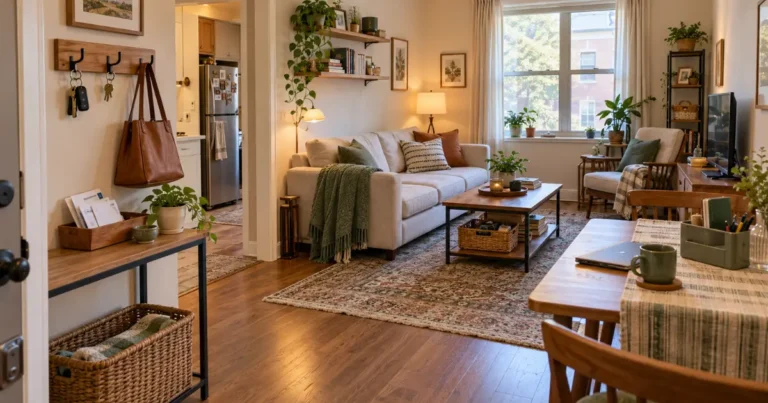
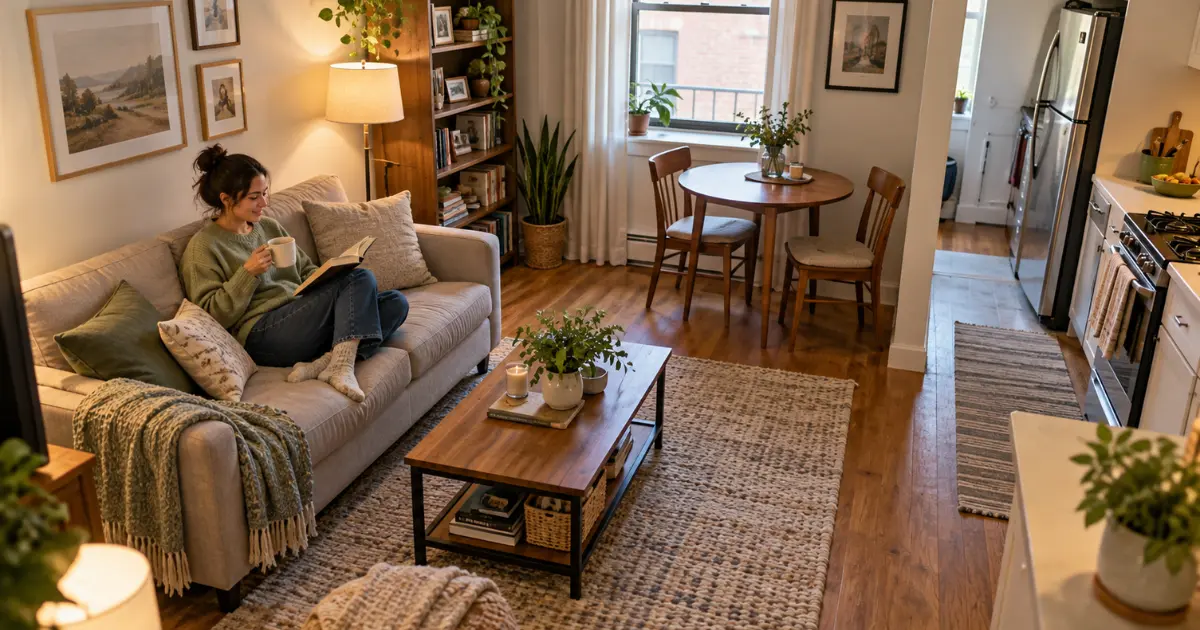
Living in a compact home can make ordinary routines feel more demanding. One surface may need to handle work, meals, and paperwork. Furniture can interfere with movement. Necessary belongings can quickly make a room feel crowded. The goal of small space living is not to squeeze more into every corner. It is to help the home support daily life with less friction.
A comfortable small home balances several needs at once: enough room to move, places for necessary belongings, furniture that makes good use of the space it occupies, lighting that supports real tasks, and enough visual openness to keep the space from feeling overloaded. The most useful changes usually come from understanding how you actually live, then adjusting the home around those priorities.
Summary Box
- Decide which daily activities deserve the most convenient space.
- Keep enough open floor area for comfortable movement and access.
- Reduce possessions that create more burden than value.
- Choose furniture based on function, scale, and clearance—not features alone.
- Use existing storage thoughtfully before adding more.
- Let one room support multiple activities without making transitions complicated.
- Keep frequently used belongings easy to reach.
- Use light, balanced furniture scale, and open sightlines to reduce visual crowding.
- In small space living, some open space is useful space.
- Make changes that fit your lease, budget, routines, and actual household needs.
Table of Contents
1. Understand What Your Small Space Needs to Support
A compact home works best when its layout reflects the way you spend your time. Before moving furniture or buying anything, identify the activities that happen most often and the areas that create the most frustration.
Identify Your Daily Activities and Priorities
Start with the basics. Where do you rest, eat, work, read, get ready, handle mail, or store the things you use most often?
Not every activity needs equal space. If you work from home several days a week, a usable work surface may matter more than an extra accent chair. If you rarely entertain but eat at home every day, everyday dining comfort may deserve more attention than occasional seating.
Think in terms of priorities rather than idealized room labels. A living room does not have to serve only one purpose, and a dining area does not have to remain untouched between meals. Living in a small space often means allowing one area to support several parts of daily life.
The key is to decide which functions need the easiest access, which can share space, and which can happen less conveniently without causing problems.
Notice the Areas That Create the Most Frustration
Recurring frustration is useful information. It often points to a mismatch between the home and your routines.
A walkway that is always blocked may indicate that a piece of furniture is too large or poorly positioned. A table that constantly accumulates unrelated items may be serving too many jobs. A chair that has to be moved every time a cabinet opens may be making access harder than it needs to be.
Look for problems that happen repeatedly, not just occasional mess.
Ask yourself:
- Where do I have to squeeze past furniture?
- Which doors, drawers, or cabinets are awkward to open?
- Which surfaces are always being cleared before they can be used?
- Which activities compete for the same spot?
- Which parts of the home feel harder to clean because access is limited?
You do not need a complete organizational overhaul at this stage. You are simply identifying where the home is creating unnecessary friction.
2. Keep Only What Supports Your Everyday Life
Limited square footage makes the cost of excess possessions easier to notice. Too much stuff can reduce movement, make cleaning harder, crowd useful surfaces, and turn simple tasks into rearranging projects.
The goal is not to strip the home down to bare essentials. It is to create enough room for the belongings and activities that matter most.
Recognize the Cost of Keeping Too Much
Every item occupies more than physical space. It also affects access, cleaning, visibility, and the effort required to put things away.
A rarely used object may seem harmless on its own. But when many low-priority possessions compete for the same cabinets, shelves, and surfaces as everyday necessities, the whole home becomes harder to use.
This is especially noticeable in tiny space living, where one crowded area can affect several functions at once.
Consider whether the things you keep are supporting daily life or making it more complicated. If you must constantly move one category to reach another, or if frequently used belongings no longer fit comfortably where you need them, the total volume may be working against you.
Make Room for What Matters Most
Keeping less is not the objective by itself. The purpose is to make room for what you value, use, and need.
That may include practical items, sentimental belongings, hobbies, books, or objects that make the home feel personal. Different households will make different choices.
A useful question is: “Does keeping this make everyday life better enough to justify the space it uses?”
You do not need to conduct a complete sorting project every time the home feels crowded. Even removing obvious duplicates, broken items, or belongings that no longer fit your routines can improve access and comfort.
If you are deciding what to do with belongings you no longer need, the U.S. Environmental Protection Agency offers practical guidance on reducing, reusing, and repairing household items before considering disposal.
3. Arrange Furniture for Comfortable Movement
Furniture can make a compact home feel functional or frustrating depending on how it affects movement. A room is not working well if it looks attractive but requires constant side-stepping, moving furniture, or awkward reaching.
Protecting circulation is one of the most practical ways to improve small space living without increasing square footage.
Protect Walking Paths and Everyday Access
Pay attention to the routes you use repeatedly: the path from the entry to the main seating area, the approach to a desk, the space around the bed, or the area needed to open a cabinet.
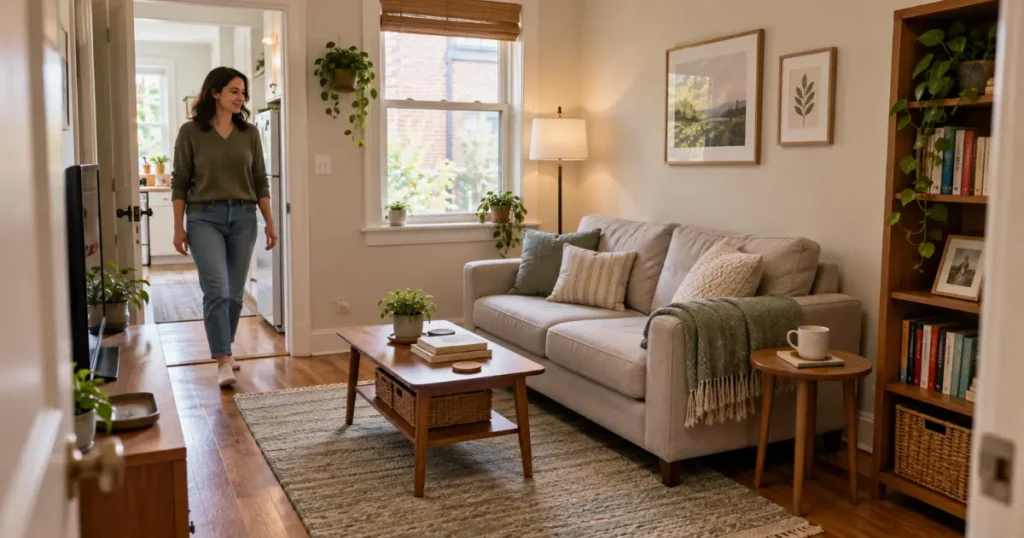
These paths do not have to be perfectly straight or unusually wide. They do need to feel usable.
Check whether furniture interferes with:
- opening doors and drawers,
- reaching frequently used belongings,
- sitting down and standing up comfortably,
- walking through the room,
- or completing normal household tasks.
Small adjustments can matter. Moving a chair a few inches, turning a table, or relocating a floor lamp may improve access without requiring any new furniture.
Choose a Layout That Supports How You Live
A useful layout reflects frequency of use.
Imagine a compact room with a sofa, small desk, and occasional guest chair. If the desk is used every day but the guest chair is used once or twice a month, the desk should not be squeezed into the least convenient corner simply to preserve a more conventional seating arrangement.
You might instead place the desk where it receives better light and access, then move the occasional chair to a less prominent position.
This is not about following one “correct” floor plan. It is about allowing daily life to influence the layout.
Avoid copying room arrangements that look appealing but do not match your routines. What matters is whether the arrangement supports movement, access, comfort, and the activities that actually happen there.
4. Make Furniture Work Harder Without Crowding the Room
In a compact home, furniture has to justify the space it occupies. That does not mean every piece must perform several jobs. It means each piece should be useful enough to justify the space it takes up.
Prioritize Furniture That Serves More Than One Purpose
Multifunctional furniture can be useful when the extra function solves a real problem.
A small dining table may also work as a project surface. A bench may provide seating while holding a limited category of belongings. A simple side table may support reading, charging, and an occasional meal.

The benefit is not the number of advertised functions. The benefit is reducing the need for separate pieces of furniture.
A storage bed is one example of multifunctional furniture that may reduce the need for another cabinet or dresser. If your bedroom has limited floor space, our guide to storage beds for small bedrooms explains how to compare drawer and lift-up designs, check clearance, and decide whether the built-in storage is worth the investment.
Before choosing a multifunctional item, ask:
- Will I actually use the second function?
- Is switching between functions easy?
- Does it replace something else I would otherwise need?
- Will it make the room more convenient or more complicated?
If the extra feature is difficult to access or rarely used, it may not add meaningful value.
Consider Scale, Clearance, and Ease of Use
A piece of furniture can be multifunctional and still be wrong for a small home.
Dimensions matter. So do clearance and access.
A table that technically fits may still make it difficult to pull out chairs. A piece with built-in compartments may require more space to open than the room provides. A large item with several functions can crowd out smaller pieces that would work better together.
Before adding or replacing furniture, consider its full footprint during use, not just when it is sitting still.
This is where living in small spaces often requires trade-offs. A slightly smaller piece with fewer features may function better than a larger item designed to do everything.
5. Use Storage Strategically, Not Everywhere
Storage should make daily life easier, not turn the home into a collection of containers.
Before adding more places to put things, look at the storage already available and ask whether it is being used in a way that supports everyday access.
Make Better Use of Existing Storage
Existing cabinets, drawers, shelves, and furniture may offer more useful storage than you initially realize.
Check whether frequently used belongings occupy convenient locations and whether low-priority items are taking up the best space.
You may find that moving an occasional-use category higher, lower, or farther away creates better access for something you use every day.
The important point is to improve function before increasing capacity. A home with more storage can still feel difficult if its contents are poorly matched to the places where they are used.
For apartment residents who have already improved their existing storage but still need more capacity, our small apartment storage ideas offer practical options that make use of limited space without compromising everyday comfort.
If you’re looking for specific ways to improve everyday storage and reduce clutter, our small space organization ideas offer practical solutions for shelves, drawers, shared surfaces, and frequently used belongings.
Consider Vertical Space Without Overloading It
Wall height and existing shelving can sometimes help in a compact home, particularly for belongings that do not need to stay at floor level.
But vertical space has limits.
Items placed too high may become inconvenient. Too many objects above eye level can make the room feel visually crowded. Wall-mounted additions may also require secure installation and may not be appropriate for every rental.
Tall bookcases, dressers, and other furniture that could tip over also require appropriate safety precautions. The U.S. Consumer Product Safety Commission provides furniture anchoring guidance to help prevent tip-over injuries.
Use height when it solves a clear problem, not simply because a wall is empty.
For bedrooms where floor space is particularly limited, explore our small bedroom shelving ideas to compare wall-mounted, bedside, corner, and freestanding shelves while keeping access and safety in mind.
Leave Some Space Open
Open space supports movement, access, cleaning, and visual comfort.
An empty portion of a shelf is not automatically wasted. A clear section of floor may make a room easier to move through. A partially open surface may allow several activities to happen there without constant rearranging.
This principle is easy to overlook because many organization messages focus on fitting more into limited square footage. In practice, small space living can become easier when you protect some breathing room instead of filling every available spot.
6. Help One Room Support Multiple Activities
One room may need to work as a living area, workspace, eating area, reading spot, or place for hobbies at different times of day.
The goal is not to make every activity permanent. It is to make transitions simple enough that the room can change functions without becoming a daily project.
Define Flexible Zones for Different Tasks
A zone can be as simple as a small desk for focused work, a seating area for relaxing, or one end of a table used for paperwork.
These areas do not need walls or physical dividers. Furniture placement, lighting, and the location of necessary belongings can be enough to give each activity a recognizable place.
The point is to reduce competition. For apartment-specific guidance, our small apartment organization guide explains how to coordinate shared surfaces, storage, and everyday activities throughout a compact apartment.
If one table supports both dining and work, for example, keeping work supplies grouped nearby can make it easier to clear the surface for meals without scattering papers throughout the room.
This is a practical way to approach small space living without turning the home into a rigid set of mini-rooms.
For readers living in a one-room studio, our guide on how to organize a studio apartment explains how to establish functional areas, manage shared surfaces, and keep everyday belongings organized without needing separate rooms.
Make It Easy to Switch Between Activities
Shared areas work best when changing from one activity to another requires only a few simple steps.
If a living room doubles as a guest sleeping area, consider how easily bedding can be brought out, put away, and stored between visits. If a seating area is also used for stretching or exercise, keep the floor easy to clear.
The more complicated the transition, the more likely one activity will permanently take over.
Good flexibility depends on ease, not cleverness. A simple setup that takes two minutes to reset is usually more useful than an elaborate system that looks efficient but requires repeated moving, unfolding, or rearranging.
7. Make a Small Home Feel Lighter and More Open
In small living spaces, comfort is partly physical and partly visual. A room can have enough floor space and still feel crowded if light is blocked, furniture is oversized, or too many unrelated objects compete for attention.
You do not need an empty or highly styled interior. The aim is to reduce unnecessary visual pressure.
Use Lighting to Improve Comfort and Visibility
Natural light can make everyday tasks easier and reduce the need for daytime artificial lighting, so avoid blocking windows unnecessarily with tall furniture or dense arrangements.
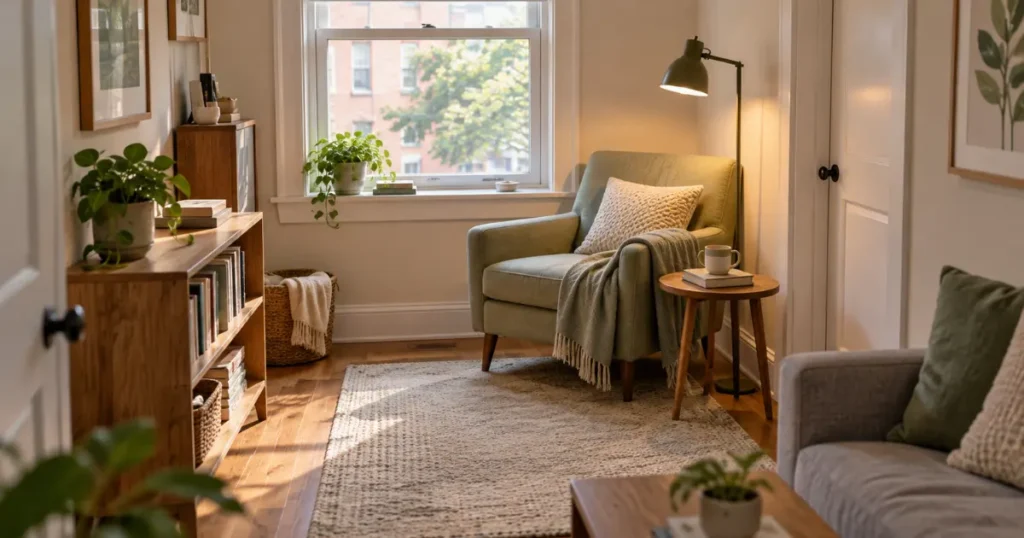
After that, think about the activities that need light.
A general ceiling fixture may not provide comfortable illumination for reading or desk work. A small task light can often improve visibility without changing the entire room.
Lighting also helps define function. A focused lamp near a chair can make a reading area feel intentional, while a desk lamp can visually separate work from relaxation.
The goal is not to brighten every corner equally. It is to put useful light where activities actually happen.
Reduce Visual Crowding Without Making the Home Feel Empty
Visual calm does not require hiding every possession.
Start by noticing large visual elements: furniture scale, repeated colors, crowded surfaces, bulky pieces, and blocked sightlines.
A room may feel more comfortable when:
- furniture is appropriately scaled,
- frequently used surfaces retain some clear area,
- decor is grouped rather than scattered,
- and large objects do not unnecessarily interrupt the view across the room.
You can still keep books, plants, artwork, and personal objects. The goal is not minimalism. It is enough visual consistency and open space to let the room feel settled rather than overloaded.
8. Create Simple Systems That Make Daily Living Easier
A compact home should be easy to use on an ordinary weekday, not only when everything has just been cleaned.
Simple systems reduce the number of small decisions you have to make every day.
Keep Frequently Used Belongings Convenient
Items used often should generally be easy to reach and easy to return.
That might mean keeping a laptop charger near the place where you work, placing everyday bags near the entry, or keeping routine paperwork close to the surface where you handle it.
The principle is convenience. If a frequently used item has a home that requires several extra steps, it is more likely to be left out.
Convenient placement helps a small home feel more functional without requiring additional square footage.
For apartment-specific examples of putting everyday belongings in more convenient places, explore our small apartment organization ideas for shared tables, entryways, storage cabinets, and other frequently used areas.
Build Routines That Prevent Daily Friction
Short, repeatable habits can prevent small problems from becoming larger ones.
A quick evening reset, returning items after use, or clearing one shared surface before switching activities may be enough to keep the space usable.
For a detailed process covering decluttering, functional zones, accessible storage, and daily maintenance, see our guide on how to organize small spaces.
The goal is not constant tidying. It is to make the next use of the space easier.
9. Make Small Space Living Work in a Rental
Renters often need solutions that improve function without assuming they can drill, rebuild, replace fixtures, or make permanent changes.
The most useful first steps are usually reversible and easy to evaluate.
Start With Reversible Changes
Rearranging existing furniture can improve circulation and access without altering the property.
You can also reconsider how current surfaces are used, move freestanding lighting, or relocate belongings so that daily activities are easier to support.
Be cautious with products marketed as removable or damage-free. Wall finishes, humidity, application methods, and removal techniques vary, so those products should not be treated as universally risk-free.
A reversible change is useful when it can be tested without creating a new maintenance or repair problem.
Check Restrictions Before Making Alterations
Lease terms and property rules differ, so check your own agreement before drilling, mounting, painting, replacing fixtures, or making other changes that may require permission.
If the lease is unclear, ask the landlord or property manager before proceeding.
The important principle is simple: do not assume a modification is allowed just because it is common in another rental.
10. Common Small Space Living Mistakes to Avoid
Several common choices can make a compact home harder to use even when they are intended to improve it.
- Filling every empty corner: More filled space can mean less movement, harder cleaning, and greater visual pressure. Leave some capacity unused when it improves comfort.
- Buying furniture before checking dimensions: A piece may fit on paper but still block doors, crowd walkways, or make other furniture difficult to use.
- Blocking important access routes: Frequently used cabinets, doors, windows, and paths should remain easy to reach.
- Prioritizing appearance over function: A photogenic arrangement is not helpful if daily routines require constant moving and resetting.
- Using too many storage products: Additional containers can create more volume and more categories to manage. Add them only when they solve a clear problem.
- Ignoring how the home is used every day: A layout that works for occasional guests but frustrates the people who live there is poorly matched to the household.
The corrective principle is consistent: let real routines, access, and comfort guide decisions.
11. Frequently Asked Questions About Small Space Living
Q: How can I make living in a small space more comfortable?
A: Start with the activities that matter most, protect clear walking paths, keep necessary belongings convenient, and reduce items that interfere with daily use. Comfort comes from making common tasks easier, not from trying to make the home look larger than it is.
Q: What matters most when choosing furniture for a small home?
A: Consider actual dimensions, clearance, frequency of use, and whether the piece supports an important activity. A smaller item that is easy to use may be more practical than a larger multifunctional piece with features you rarely need.
Q: How do I avoid feeling overwhelmed by belongings in a small home?
A: Reduce the amount competing for limited space, keep high-use items accessible, and review categories that regularly overflow. You do not need to remove everything; the goal is to keep the volume of possessions compatible with the space and your routines.
Q: Can a small home feel spacious without major renovations?
A: It can often feel more open and comfortable through better furniture placement, clearer pathways, appropriate scale, useful lighting, and less visual crowding. Those changes do not increase square footage, but they can improve how the available space feels and functions.
12. Final Thoughts
Successful small space living depends less on how much a home can hold and more on how well it supports the people using it.
A compact home can be comfortable when movement is protected, furniture fits both the space and the routine, necessary belongings are convenient, and some room is left open rather than filled automatically.
Start with one practical improvement: clear a blocked path, rethink one piece of furniture, improve one shared surface, or move a frequently used item closer to where you need it. Small changes are often easier to maintain, and they give you useful information about what the home needs next.