Small Apartment Organization: A Complete Guide
A small apartment can be challenging to organize because each area often needs to serve several purposes. The same room may support relaxing, dining, working, entertaining, and storing everyday belongings, while closets and cabinets offer limited capacity. Effective small apartment organization is therefore less about adding containers and more about deciding what deserves space, keeping important items accessible, and making different parts of the apartment work together.
A practical system should support the way you actually live. That means matching your belongings to the space available, using existing storage thoughtfully, creating clear organization zones, and choosing routines that are simple enough to maintain.
This guide explains the broad principles that make a compact apartment easier to manage, how priorities change from one area to another, and how to deal with common challenges such as rental restrictions, shared spaces, limited storage, and a modest budget.
Summary Box — Small Apartment Organization at a Glance
- Prioritize belongings that are useful, meaningful, or necessary when space is limited.
- Keep everyday essentials in convenient locations rather than using prime space for rarely needed items.
- Create practical organization zones around real activities and routines.
- Make better use of existing cabinets, closets, drawers, and shelves before adding more storage.
- Keep organization consistent across apartment areas so clutter isn’t simply shifted from one room to another.
- Use simple routines that make the system easy to maintain and adjust over time.
Table of Contents
Why Small Apartment Organization Requires a Different Approach
Organizing a small apartment involves more than managing the same household belongings in less space. Limited usable space means that one problem can affect several parts of daily life at once.
A dining table, for example, may also be a work surface. The living area may need to handle relaxation, exercise, guests, and household paperwork. A closet may have to accommodate clothing, linens, luggage, and seasonal belongings.
If you live in a studio where sleeping, working, dining, and relaxing all happen within one main room, our guide on how to organize a studio apartment provides a practical ten-step approach designed specifically for that shared-space arrangement.
When several activities compete for the same square footage, organization decisions need to reflect how the space is actually used. The question is not only, “Where can this fit?” It is also, “Does this location make everyday life easier?”
Imagine a compact apartment where the dining table becomes a work area during the day. If office supplies stay scattered across the table after work, dinner requires a cleanup project every evening. A better organization system would support both activities without permanently giving the surface to either one.
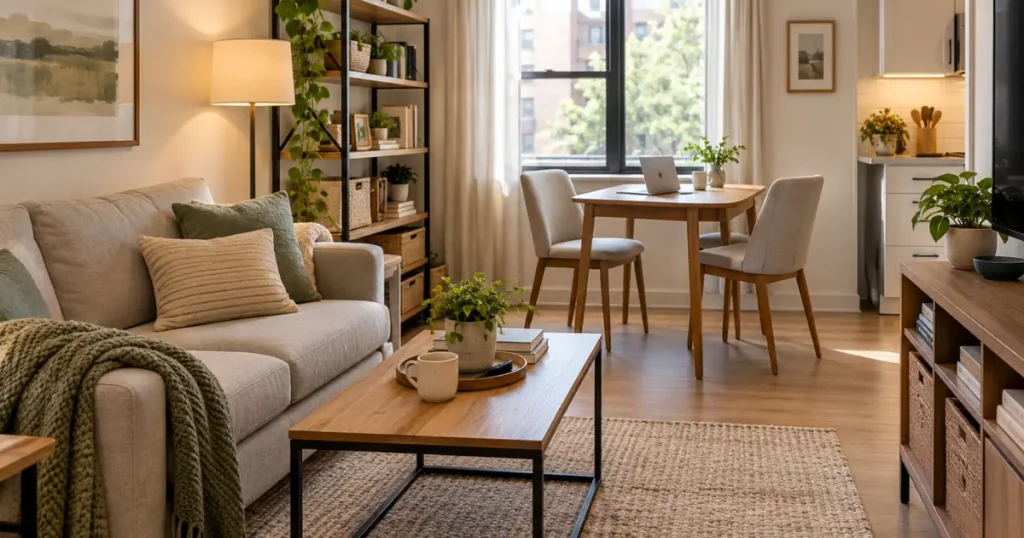
This is why organizing small apartments requires coordination. Belongings, available storage, shared surfaces, and daily activities all influence one another.
The goal is not to fill every unused corner. Some open space is necessary for movement, access, cleaning, and switching between activities.
The Core Principles of an Organized Small Apartment
A functional apartment organization system usually depends on a few connected principles. They are not rigid steps that must be completed in a particular order. Instead, they help guide individual decisions throughout the home.
Make Room for What Matters Most
In a small apartment, deciding what deserves space is just as important as deciding where to store it.
If cabinets, closets, drawers, and surfaces are consistently overcrowded, organization alone cannot always solve the problem. Some belongings may need to be reconsidered so useful and meaningful items have enough room to function properly.
This does not mean adopting an extreme minimalist approach or removing anything that is not essential. Decorative objects, hobbies, sentimental belongings, and occasional-use items can all deserve space.
The useful question is whether the amount you keep is compatible with the apartment you have.
A category that constantly spills into unrelated areas may need more thoughtful limits. Perhaps some duplicates are unnecessary, some items are no longer used, or a rarely needed category is occupying space better suited to daily essentials.
The goal is to give the belongings you value and use enough room without allowing less important items to take over the apartment.
Keep Everyday Belongings Accessible
Frequently used items should generally receive the easiest-to-reach locations.
If you use something every day, storing it behind several other objects or on an inconvenient shelf creates unnecessary friction. Less frequently used belongings can usually tolerate less convenient positions.
For example, everyday dishes may deserve the most accessible kitchen cabinet, while serving pieces used a few times a year can occupy a higher shelf.
The same idea works throughout the apartment. A frequently used bag makes more sense near the entry than buried inside a bedroom closet. Current paperwork may be easier to manage in a nearby drawer or tray, close to where you normally handle it.
Good apartment organization considers both retrieval and return. If putting something away is inconvenient, even a neat system can break down quickly.
Create Practical Organization Zones
A zone groups an activity with the belongings that support it.
A small entry zone might handle keys and an everyday bag. A compact work zone might keep a laptop charger, notebook, and active paperwork together. A reading area could keep current books and reading glasses nearby.
Zones are especially useful in multipurpose spaces because they reduce unnecessary movement and prevent unrelated belongings from spreading across the room.
They do not need physical partitions or dedicated furniture. A drawer, part of a cabinet, a small tray, or one section of a shared surface may be enough.
The most effective organization zones reflect your everyday habits. If you consistently use an item in one place but store it somewhere else, the current system may be working against your routine.
If you need a structured process for sorting belongings, creating functional zones, and assigning items practical homes, our guide on how to organize small spaces explains the steps in detail.
Make Better Use of Existing Apartment Storage
Before adding another cabinet, cart, shelf, or collection of containers, look closely at the storage the apartment already provides.
Existing closets, drawers, cabinets, and shelves may not be used in ways that match the household’s current priorities.
The objective is not simply to increase capacity. It is to make available storage easier to use. If your existing cabinets, shelves, and furniture cannot accommodate everything you need to keep, explore our small apartment storage ideas for practical ways to use vertical space, hidden compartments, and overlooked areas without unnecessarily crowding your home.
Use Vertical and Overlooked Space
Compact apartments sometimes have useful space above, below, or beside existing storage areas.
Adjustable shelves in a tall cabinet may be positioned too far apart for the items they hold, leaving useful space unused. An existing shelf may have unused height above short belongings. A suitable door or narrow wall may occasionally support lightweight organization when installation is permitted.
Use these areas selectively.
Vertical storage becomes less useful when frequently needed items are placed beyond comfortable reach or when too many objects create visual crowding. Likewise, no storage addition should interfere with a doorway, walking path, ventilation, or other necessary access. Keeping exits clear is also important for safety. The U.S. Fire Administration recommends making sure doors and windows are not blocked as part of a home fire escape plan.
Renters should check lease requirements before drilling or making permanent changes. Any wall-mounted item should also be installed according to the manufacturer’s instructions and appropriate for the surface and intended load.
Balance Storage Capacity With Accessibility
More capacity is not automatically better organization.
A cabinet packed completely full may technically hold more, but everyday items become frustrating to retrieve if several objects must be moved first.
Imagine a deep cabinet holding both daily supplies and rarely used seasonal items. If the occasional items occupy the front, the household repeatedly moves them to reach what is needed every day.
A more practical arrangement gives frequent-use belongings the easiest access and places lower-priority items where slightly more effort is acceptable.
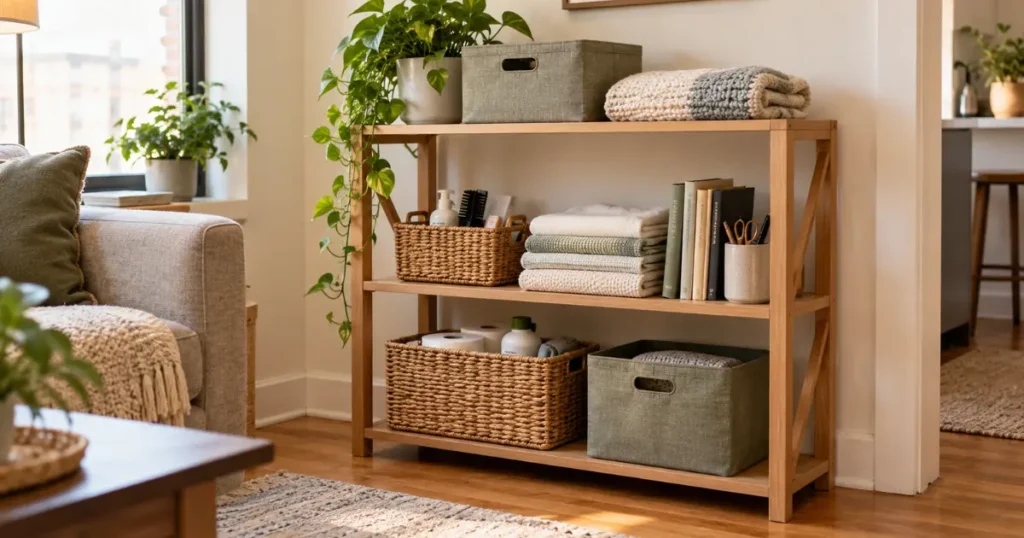
This balance is especially important in small apartments with deep shelves or limited cabinet space. A small amount of unused capacity can actually make storage easier to maintain because items can be removed and returned without rearranging everything around them.
Organization Priorities for Each Apartment Area
Different parts of an apartment create different organizational pressures. Understanding the main priorities in each area helps you make better organization decisions without creating unnecessarily complicated systems.
Entryway and Living Area
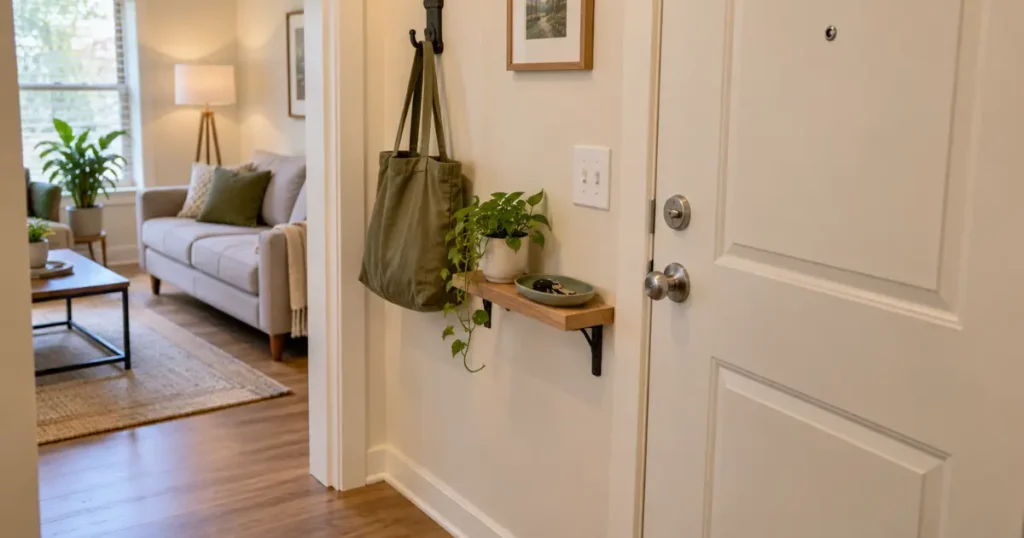
The entryway handles transitions between home and outside life, so frequently carried belongings need convenient places that do not obstruct the doorway.
Keys, an everyday bag, or incoming mai may benefit from a small defined landing area. Keep the setup proportional to the available entrance rather than creating a bulky storage zone.
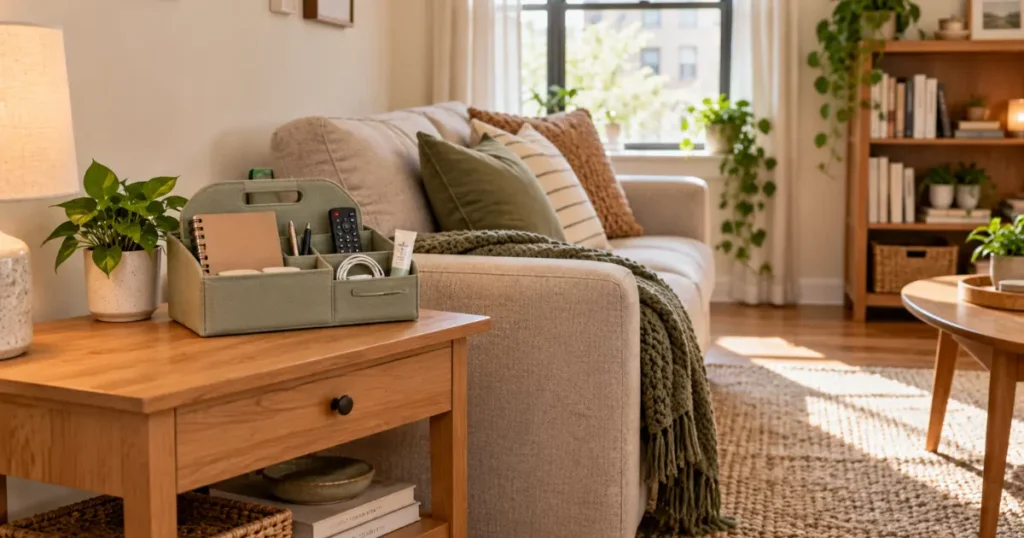
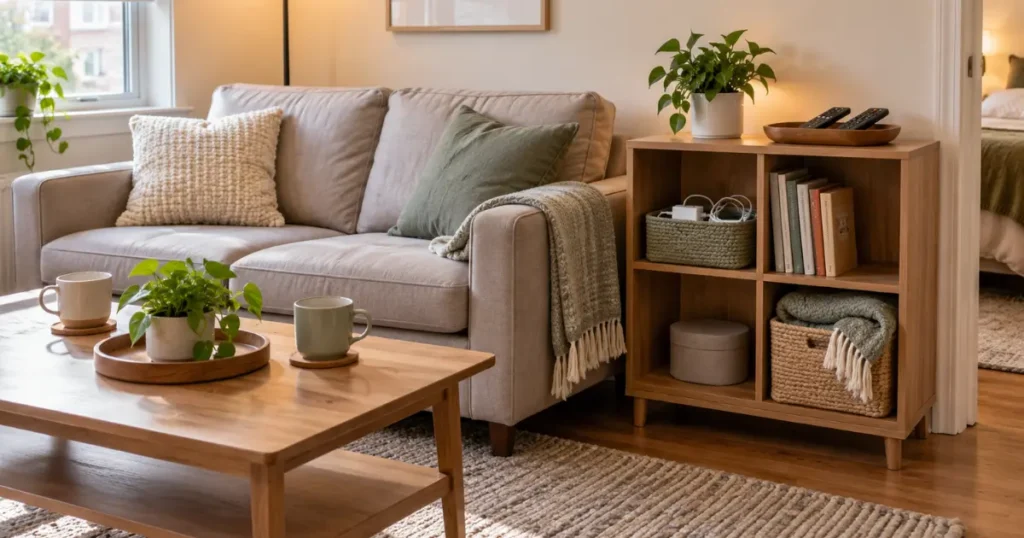
In the living area, pay attention to shared surfaces and multipurpose use. A coffee table or side table can easily become a holding place for unrelated objects if those items lack better homes.
Keep frequently used living-area belongings nearby, but protect enough surface and floor space for the room’s actual activities.
Kitchen and Dining Area
A compact kitchen works best when everyday tools, dishes, and ingredients are convenient to reach without crowding the counters.
Give the easiest cabinet and drawer locations to items used most often. Store lower-frequency items farther away when necessary.
Counter space is particularly valuable in a small kitchen because it supports food preparation and cleanup. Avoid treating every open section as permanent storage.
If the dining table serves several purposes, organize supporting belongings so the surface can change functions without extensive clearing and rearranging. Work supplies, for example, are easier to move when they are kept together rather than scattered across the table.
Bedroom and Closet
Bedroom organization should support dressing, rest, and the belongings needed around those routines.
Keep regularly worn clothing reasonably accessible and avoid allowing rarely used items to consume all of the easiest closet positions.
Bedside belongings also benefit from limits. A nightstand can quickly become a general-purpose storage area if unrelated objects accumulate there.
If the closet serves several categories, separate them clearly enough that everyday clothing does not become difficult to retrieve.
Whether your closet is large or small, its most accessible spaces should support the clothing and belongings you use most often.
Bathroom and Utility Areas
Bathrooms often combine limited cabinet space with numerous small supplies.
Keep frequently used products conveniently accessible and avoid allowing backups or rarely used items to overwhelm prime locations. Small categories are easier to manage when their boundaries are clear.
Utility areas create similar pressure. Laundry products, cleaning supplies, spare household items, and miscellaneous tools can easily become mixed together. Store cleaning products securely according to their labels, keeping them away from children, pets, and items they could contaminate.
The goal is not to build an elaborate system. Give related items understandable locations and avoid keeping more supplies in a compact area than can be stored safely and accessed conveniently. Keep cleaning products in their original containers and store them safely away from children and pets. The American Academy of Pediatrics offers additional cleaning-product safety guidance for households.
Common Small-Apartment Organization Challenges
Even a well-planned organization system has to work within the limitations of the apartment itself. Some homes offer little built-in storage, some rentals restrict physical changes, and some spaces are shared by several people.
Limited Built-In Storage
When closets and cabinets are scarce, the first priority is to decide which categories genuinely need the limited enclosed storage.
Reserve the easiest-to-reach storage locations for everyday essentials rather than rarely used belongings.
Then look at whether the available storage is being used efficiently. Adjustable shelves, existing drawers, and appropriate furniture compartments may provide opportunities without requiring an entirely new system.
Avoid responding to limited storage by automatically adding furniture to every available wall. Additional capacity can reduce usable floor space and make a compact apartment feel harder to navigate.
In apartments with almost no built-in storage, finding the right balance between keeping essential belongings accessible and preserving usable floor space becomes especially important.
Renter Restrictions
Rental apartments often require reversible approaches.
Start with what can be improved without altering the property: rearranging belongings within existing furniture, using portable organizers, improving drawer or shelf use, and choosing freestanding solutions where appropriate.
Do not assume that drilling, painting, wall mounting, or adhesive products are automatically permitted or damage-free. Lease terms, surfaces, and property policies vary.
If a change could affect the apartment itself, check the lease or ask the landlord or property manager before proceeding. Tall bookcases and other storage furniture may also need to be secured against tipping. The U.S. Consumer Product Safety Commission provides guidance on anchoring furniture to prevent tip-over injuries. Renters should confirm acceptable installation methods with their property manager.
Renter-friendly organization is most useful when it improves function without creating a repair problem later.
Shared Living Spaces
An organization system used by several people needs to be understandable to everyone who uses it.
If one person creates highly detailed categories that other household members cannot easily follow, the system may fail even if it looks neat at first.
Keep shared locations intuitive.
A common entry area might have clearly understood homes for keys, bags, and outgoing items. Shared kitchen storage should place frequently used household essentials where everyone can reach them.
It can also help to distinguish shared belongings from personal ones. Not every drawer or shelf needs to be communal.
The goal is to reduce repeated disagreements and uncertainty about where things belong.
Limited Organization Budget
Useful organization does not always require buying new products.
Before spending money, consider whether the problem can be solved by changing how existing storage is assigned.
A drawer you already have may work better for frequently used items. A clean, sturdy box you already own can keep related belongings together on a shelf. A tray can sometimes be repurposed to contain a few loose essentials.
If something new is genuinely needed, define the problem and measure the available space before buying.
A lower-cost system that fits the household’s routine is often more useful than a coordinated collection of organizers that adds complexity.
For practical examples, explore our small space organization ideas, including repurposed containers, simple drawer organizers, portable workstations, and budget-friendly ways to improve existing storage.
How to Maintain an Organized Small Apartment
Organization is not a one-time arrangement. Routines change, belongings come and go, and a system that worked six months ago may become inconvenient.
Maintenance should therefore be simple enough to fit normal life.
Establish Simple Daily Habits
Focus on the areas that experience the most daily movement.
Returning keys to their usual location, clearing a multipurpose table after use, putting everyday belongings back in their assigned places, and sorting incoming mail before it piles up can prevent clutter from accumulating.
Avoid creating rigid schedules that make the apartment feel like a constant maintenance project.
A useful routine should reduce work, not create another obligation.
If putting things away requires too many steps, the problem may be the system rather than the household’s discipline.
Review and Adjust Organization Systems
Pay attention to patterns.
If the same drawer constantly overflows, a category may have grown too large or the location may no longer suit it. If household members repeatedly leave an item on a particular surface instead of putting it away, its assigned storage location may be inconvenient.
Suppose a household stores everyday charging cables inside a closed box on a high shelf, but the cables are continually left beside the sofa. Moving the frequently used cables closer to the seating area may be more practical than repeatedly correcting the behavior.
Good organization systems adapt as routines change.
A small apartment has little room for arrangements that look tidy but are awkward to maintain.
Where to Focus Next in Your Small Apartment
The best way to improve small apartment organization depends on which challenges are causing the most difficulty in your daily life.
If belongings are scattered throughout your apartment and nothing seems to have a consistent place, start by establishing a practical organizing system that fits your routines and available space.
If you’re ready to put that system into practice, follow our guide on how to organize a small apartment. It walks you through eight manageable steps, from identifying problem areas to testing your new storage arrangements.
If your apartment already has a basic system but still feels cramped or inconvenient, explore our 17 small apartment organization ideas for practical ways to improve entryways, shared surfaces, drawers, cabinets, kitchens, bathrooms, and bedrooms.
When excess belongings are the main problem, reducing clutter may be more effective than adding storage containers. If limited storage capacity is the bigger concern, focus on solutions that preserve floor space while keeping everyday essentials accessible.
When excess belongings are the main problem, reducing clutter may be more effective than adding storage containers. Our guide on how to declutter a small apartment explains how to sort belongings, make practical keep-or-remove decisions, and clear unwanted items without overwhelming your living space. If limited storage capacity is the bigger concern, focus on solutions that preserve floor space while keeping everyday essentials accessible.
Other challenges may require different approaches. A limited budget calls for making the most of what you already own, while rental restrictions may favor portable and reversible solutions. Small closets and apartments with very little built-in storage also benefit from carefully chosen priorities.
Start with the problem that causes the most daily frustration. As you make improvements, consider how each change affects the rest of your apartment so the entire space becomes easier to use and maintain.
Frequently Asked Questions About Small Apartment Organization
What should I organize first in a small apartment?
Start with the area that causes the most repeated disruption.
That might be an entry where belongings pile up, a kitchen counter that cannot be used comfortably, or a shared table that is constantly covered.
Addressing one high-friction area can improve everyday life while helping you understand what kind of organization system the rest of the apartment needs.
Once that area is easier to manage, use what you learned to identify the next space that needs attention.
How can I organize a small apartment without buying more storage furniture?
Begin with the storage and furniture you already have.
Reconsider which belongings occupy the easiest-to-reach drawers, cabinets, and shelves. Group related items, give frequently used belongings convenient locations, and use existing compartments more intentionally.
You may find that the apartment needs better use of available storage rather than more furniture.
If additional capacity is eventually necessary, you will then have a clearer idea of the specific problem it needs to solve.
How do I keep shared apartment spaces organized?
Use systems that are simple enough for everyone to understand.
Agree on obvious homes for frequently shared belongings and keep common categories easy to access. Avoid overly complicated rules or highly specific arrangements that only one person understands.
It also helps to decide which storage areas are shared and which are reserved for personal belongings.
Shared organization works best when the system matches household behavior rather than relying on constant reminders.
Is it better to organize a small apartment by room or by category?
Both approaches can be useful.
Organizing by room is practical when one area has a clear functional problem, such as an overloaded entryway or clutter-prone bathroom.
Organizing by category can be more helpful when one type of belonging is scattered across several areas—for example, paperwork, charging cables, or cleaning supplies.
Use whichever approach makes the problem easier to understand without spreading the project unnecessarily across the entire apartment.
Conclusion
Effective small apartment organization involves more than making belongings look neat. A practical system considers what you own, where you store it, how different areas are used, and how easily the arrangement can be maintained.
Reserve the most accessible storage for everyday essentials. Make thoughtful use of existing cabinets and shelves, create clear organization zones, and adjust your systems when they no longer fit your routines.
Start with the area of your apartment that causes the most daily frustration. Improve how that space functions, then apply what you learn to other areas of your home.