How to Organize Small Spaces: A Practical Step-by-Step Guide
Small spaces can be harder to organize because the same area often has to serve several purposes. Furniture, everyday belongings, and daily routines compete for limited room, and even a little clutter can make the space harder to use.
The key to learning how to organize small spaces isn’t finding more places to put things. It’s creating a system that determines what belongs, where each category should live, how easily items can be reached and put away, and how much open space is needed for everyday activities.
The process works best in a deliberate order: reduce what you own, organize what remains around daily use, and add organizers only when they solve a specific problem. The goal is a space that’s easier to use and maintain—not simply one that holds more stuff.
Summary Box
If you want to understand how to organize small spaces without simply shifting clutter from one place to another, follow this sequence:
- Define the space: Decide what activities the space needs to support.
- Declutter: Remove items you no longer need, use, or want to keep.
- Group belongings: Put similar items together so you can see how much room each category needs.
- Establish zones: Give different activities clearly defined areas when one space serves multiple purposes.
- Assign homes: Decide where each retained item should live.
- Prioritize accessibility: Keep frequently used items in the easiest-to-reach locations.
- Use existing space intelligently: Look beyond floor space without filling every available inch.
- Choose organizers only when necessary: Measure first and buy only what solves a specific problem.
- Reduce visual clutter: Protect some open surfaces and contain small loose items where useful.
- Maintain the system: Use simple resets and periodic decluttering to prevent buildup.
Table of Contents
1. Decide What the Small Space Needs to Do
When organizing small spaces, it’s tempting to start by buying containers, adding shelves, or rearranging furniture. But first, decide what the space needs to do. A more useful starting point is function.
Before deciding where anything belongs, determine what the space actually needs to accomplish. A compact area becomes especially difficult to organize when several activities are competing for the same limited square footage.
The goal is not to make every inch hold something. The goal is to make the space support everyday life with as little friction as practical.
List the Activities the Space Must Accommodate
Start by identifying what regularly happens in the space.
A single compact area might be used for relaxing, working, dressing, reading, exercising, eating, or handling household paperwork. You do not need to redesign the room around each activity, but you do need to recognize which activities are legitimate demands on the space.
Ask:
- What do I do here every day?
- What happens here several times a week?
- Which activities genuinely need to happen in this space?
- Which activities could happen more comfortably somewhere else?
- What belongings are required for each activity?
This exercise helps separate functional needs from accumulated possessions.
For example, if you regularly work in a compact multipurpose space, a few work-related items may deserve convenient access. A large collection of rarely used supplies may not.
One of the best ways to organize a small space is to let its everyday activities guide what deserves convenient access.
Organizing belongings is only one part of making a compact home functional. For broader ideas on furniture arrangements, comfortable movement, multifunctional spaces, and everyday routines, explore our guide to small space living.
Identify What Is Making the Space Difficult to Use
Next, identify the specific source of friction.
Do not simply label the space “cluttered.” Try to diagnose why it feels difficult to manage.
Common problems include:
- too many possessions for the available space,
- frequently used items stored in inconvenient places,
- belongings with no established home,
- several activities competing for the same surface,
- prime locations occupied by rarely used items,
- categories scattered throughout the space,
- or poor use of available vertical or overlooked areas.
Notice which problems happen repeatedly.
If a surface becomes cluttered every evening, for example, the problem may not be a lack of discipline. The items landing there may simply lack convenient homes.
A lasting organization system addresses why clutter accumulates instead of requiring you to clear the same mess again and again.
2. Declutter Before You Start Organizing
Decluttering matters in every home, but it becomes especially important when available space is limited.
No organization system can indefinitely compensate for having more possessions than a compact area can comfortably support. You may be able to arrange excess belongings more neatly for a while, but if shelves, drawers, surfaces, and other usable areas remain packed to capacity, everyday access and maintenance will still be difficult.
If your goal is to declutter a small space, focus less on achieving a particular aesthetic and more on reducing competition for limited room.
If you live in an apartment where excess belongings are crowding several rooms, our guide on how to declutter a small apartment provides a more focused process for deciding what to keep, what to remove, and how to make progress without creating additional clutter.
Decide What Deserves Space
Every possession uses some combination of physical space, visual attention, and maintenance effort.
Instead of asking only, “Could I use this someday?” ask more practical questions:
- Do I use this?
- Does it support an activity that actually happens here?
- If I needed more room for everyday activities, would I still choose to keep this?
- Does keeping it make frequently used belongings harder to access?
- Is it valuable enough to justify the space it occupies?
This does not mean you need to keep only necessities. Sentimental, decorative, and occasional items can still deserve space.
The important point is that keeping something should be an intentional decision rather than the default result of never reconsidering it.
When organizing a small space, each retained item should earn its place through usefulness, meaning, or genuine enjoyment.
Remove Duplicates, Broken Items, and Things You No Longer Use
Easy decisions can create useful breathing room before you tackle harder ones.
Look first for possessions that are:
- broken beyond worthwhile repair,
- expired or unusable,
- duplicates you do not realistically need,
- no longer appropriate for your current routines,
- or retained mainly because you have not decided what to do with them.
Be careful with duplicates. Two of an item may be entirely reasonable if both are regularly used. Five may be unnecessary if four remain untouched.
The point is not to follow arbitrary decluttering rules. It is to compare the amount you own with the amount you actually use and the space available to support it.
Get Outgoing Items Out of the Space
A decluttering decision is not complete while unwanted belongings remain in bags, boxes, or piles inside the same area.
Create a realistic exit path for anything you decide to donate, recycle, return, give away, or discard. Then move those items out promptly.
For practical advice on donating usable belongings and reducing household waste, consult the EPA’s tips for reducing, reusing, and recycling at home.
Otherwise, decluttering can temporarily create even more visual and physical clutter.
If several decisions require follow-up, keep outgoing items together in one designated place rather than allowing separate piles to develop throughout the space.
Once unwanted possessions are removed, it’s easier to see how much space the things you’re keeping actually need.
3. Group What Remains Before Finding It a Home
Once unnecessary possessions are removed, resist the urge to put everything away immediately.
Instead, group what remains.
This stage is easy to skip, but it is important because it reveals the real size of each category. It is difficult to know where something should live when related items are scattered across several locations.
Grouping also prevents you from buying organizers for a category before you know how much space that category actually needs.
Keep Similar Items Together
Identify related belongings, then gather them in one place when practical.
The categories should reflect how you use things rather than an overly complicated classification system.
For example, several small items used for the same routine may make more sense as one functional category than as multiple highly specific subcategories.
The purpose is clarity.
You want to be able to see:
- what you own,
- how many similar items you have,
- whether additional decluttering is needed,
- and how much space the category realistically requires.
That’s why learning how to organize small spaces works better as a step-by-step process than as a collection of unrelated tips. The correct home for a category becomes much easier to identify after you understand its actual volume.
Separate Everyday Items From Occasional Items
Not everything deserves equally convenient access.
Within each category, separate everyday items from things you use only occasionally.
Items used every day or several times a week should generally be easier to reach than items needed only occasionally. Seasonal, backup, or infrequently used possessions can usually tolerate a less convenient location.
This simple distinction protects valuable prime space.
Without it, rarely used belongings can occupy the most accessible areas while everyday items are pushed into inconvenient locations.
That creates friction every time you need something and every time you put it away.
Effective organization for small spaces depends as much on access hierarchy as on neatness.
Knowing each category’s size and frequency of use will help you create practical zones and assign logical homes in the next steps.
4. Create Zones When One Small Space Has Multiple Jobs
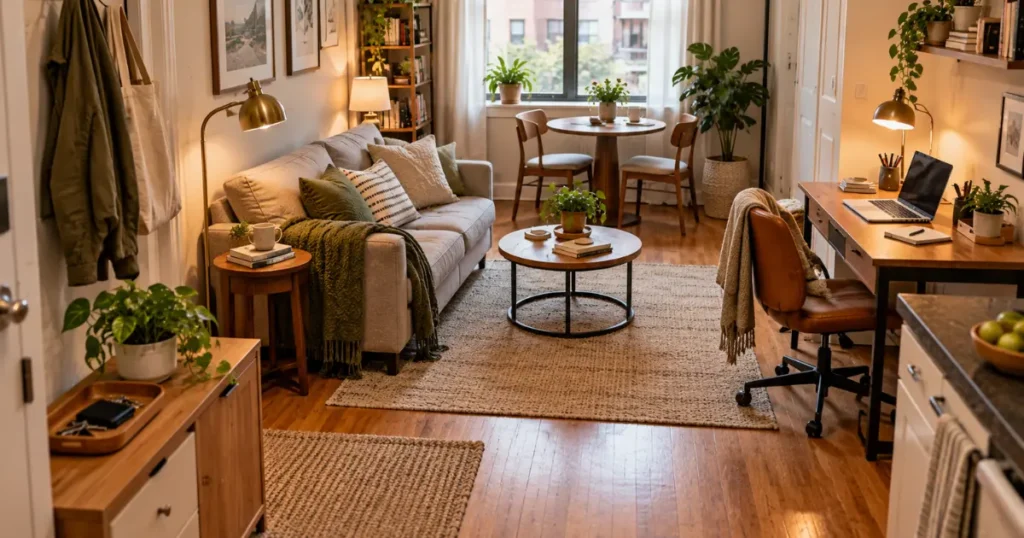
A compact space becomes easier to manage when different activities have recognizable zones.
A zone does not need a wall, divider, or special piece of furniture. It is simply a defined area where one activity happens and where the possessions supporting that activity are kept.
Zoning is especially helpful when one room or area serves several functions.
Give Each Activity a Defined Area
Use the activity list you created earlier and decide where each function works most naturally.
The boundaries can be simple.
One surface might support focused work during the day. Another small area may handle reading or relaxation. A particular drawer, basket, cabinet section, or portion of a surface might support a specific routine.
What matters is that unrelated categories are not constantly competing for the same space.
Try to avoid creating more zones than you can maintain. Too many tiny categories and boundaries can make a system complicated rather than helpful.
The most practical small space organization ideas make everyday activities easier without adding unnecessary rules or complicated routines.
If you’re organizing an entire apartment rather than one compact area, our small apartment organization guide explains how to coordinate storage, everyday belongings, and functional zones across different rooms.
Keep Belongings Close to the Zone Where They’re Used
Think about where each activity happens and keep the belongings that support it in the same general area whenever practical.
For example, if one surface is regularly used for paperwork, the supplies needed for that activity should be nearby rather than scattered throughout the space.
Pay attention to activities that repeatedly spread into unrelated areas. This may indicate that a zone needs clearer boundaries or that the belongings supporting it are too widely distributed.
When deciding how to organize a small room, think of zones as a way to keep related activities and possessions working together.
At this stage, identify which zone each category belongs to. The next step is to decide exactly where individual items should live within those zones.
5. Give Every Item a Logical Home
“Everything needs a home” is common organizing advice, but the location of that home matters.
If the assigned place is inconvenient, overcrowded, difficult to access, or unrelated to where the item is used, possessions are more likely to end up on open surfaces instead.
A logical home makes both retrieval and cleanup easier.
Put Frequently Used Items Within Easiest Reach
Prime locations should serve your most frequent routines.
The exact locations differ from one space to another, but the principle stays the same:
- Place everyday items where you can reach them comfortably without moving other belongings.
- Keep less frequently used items in secondary locations, such as the back of a shelf or a less convenient drawer.
- Reserve harder-to-reach locations for occasional belongings, provided they can still be retrieved safely.
This prevents low-priority possessions from consuming the easiest-to-use space.
Accessibility also needs to reflect the person using the space. A convenient location should not require awkward reaching, unnecessary moving of other items, or repeated rearranging.
Make Items Easy to Put Away, Not Just Easy to Retrieve
A system can look efficient until it is time to clean up.
If returning an item requires opening several containers, moving another category, rearranging contents, or completing multiple steps, the system may be too complicated for everyday use.
Whenever possible, reduce the effort required to reset the space.
Ask:
- Can I put this away in a few seconds?
- Do I have to move something else first?
- Is the assigned area already too full?
- Would I realistically return this item here when I am busy?
One of the most practical organizing tips for small spaces is to judge how easily items can be put away—not just how tidy everything looks.
Keep the Item’s Home Close to Its Point of Use
Point-of-use organization reduces unnecessary movement and makes routines more intuitive.
An item does not always need to live in the location that seems most conventional. It should usually live where it is most useful, provided that location does not interfere with other priorities.
If something consistently migrates from its assigned home to another location, pay attention. Repeated clutter can be feedback.
If an item repeatedly ends up somewhere else, try giving it a home closer to where you actually use it. Then see whether it gets put away more consistently.
6. Use the Space You Already Have More Efficiently
Once belongings have been edited, grouped, zoned, and assigned logical homes, look at how efficiently the existing space is being used.
This does not mean filling every gap.
When learning how to organize small spaces, remember that fitting more belongings into an area doesn’t necessarily make that area easier to use.
Look Beyond Floor Space
When floor area is limited, look at the full dimensions of the space.
Walls, the backs of appropriate doors, the vertical space within existing furniture, and other overlooked areas may sometimes help support organization.
The key word is sometimes.
An overlooked area is useful only when it gives a necessary category a more logical home or improves access. Using vertical space simply because it is available can create visual crowding and make the space feel harder to maintain.
Think in terms of function before capacity.
Looking beyond the floor can help you make better use of the space you already have without increasing the amount you own.
If you use freestanding bookcases or other tall storage furniture, consider tip-over safety as well. The U.S. Consumer Product Safety Commission provides furniture anchoring guidance to help prevent tip-over injuries.
Keep Floors and Important Surfaces as Clear as Practical
Open floor area supports movement. Clear portions of important surfaces make everyday tasks easier.
That does not mean floors and surfaces must remain completely empty. It means they should not become the default home for possessions that lack another place.
Protect the areas you need for regular activities.
If an important surface is constantly covered, determine whether:
- too many categories are competing for it,
- possessions lack homes,
- the available homes are inconvenient,
- or the surface is being asked to serve too many functions.
Clearing it repeatedly without addressing the cause will provide only temporary relief.
Don’t Fill Unused Space Simply Because It Exists
Unused space isn’t automatically wasted space.
A gap on a shelf, an open section of wall, or part of a surface may make belongings easier to reach and leave more room for everyday activities.
Leaving some capacity unused can also make a system easier to maintain. When every shelf, drawer, and compartment is packed tightly, putting one item away often requires rearranging several others.
That friction encourages clutter.
Some organization hacks for small spaces promise to turn every available inch into usable capacity. That can occasionally be helpful, but it should not become the goal.
A well-organized small space needs room to function, not merely room to hold things.
7. Choose Organizers Only After You Know What You Need
Organizers can support a good system, but they cannot create one for you.
Buying them too early often creates a new problem: now the space must accommodate both the original possessions and organizers that may not fit the belongings, the available area, or the way the space is actually used.
Before buying anything, declutter, group categories, decide where they need to live, and identify a specific problem that an organizer would solve.
Measure the Available Space Before Buying Anything
Never rely on visual estimates when fit matters.
Measure the usable dimensions:
- width,
- depth,
- and height.
For enclosed spaces, measure the opening as well. A container might fit inside a cabinet or drawer but still be difficult to insert or remove.
Also consider access.
An organizer may technically fit inside an area but still be inconvenient if a door cannot open properly, contents become difficult to reach, or nearby objects have to be moved every time you use it.
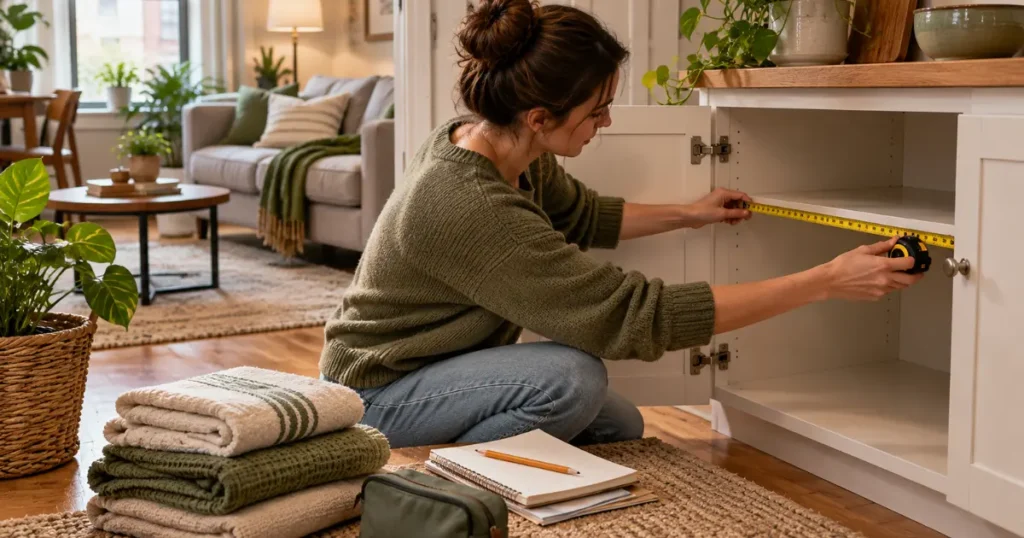
Write down the measurements before comparing options.
This small step can prevent wasted money and help you choose something that uses the available area appropriately without overcrowding it.
Match the Organizer to the Belongings
Start with the category, not the product.
Ask what the organizer actually needs to do.
Does the category need simple containment? Separation? Easier visibility? Faster access? A clear physical limit?
Choose only after answering those questions.
A container that is too large can encourage a category to expand unnecessarily. One that is too small creates overflow and makes the system look untidy even when you are trying to follow it.
The best organizer is not necessarily the one that holds the most. It is the one that supports the category and makes the system easier to use.
Avoid Organizers That Create More Clutter
Organizing products become clutter when they do not solve a real problem.
Before bringing one home, ask:
- Do I know exactly what will go in it?
- Do I know exactly where it will live?
- Have I measured that location?
- Will it make access or cleanup easier?
- Am I buying it to solve a problem, or simply because it looks useful?
The most useful organization ideas for small spaces solve a specific problem rather than add more containers or products to an already crowded area.
For practical examples you can adapt to your home, explore our 21 small space organization ideas, including simple ways to organize everyday belongings, shared surfaces, and existing storage.
8. Reduce Visual Clutter in a Small Space
A space can be physically organized and still feel visually busy. Knowing where everything belongs doesn’t necessarily mean the room looks calm or uncluttered.
You may know exactly where every possession belongs while still seeing many colors, labels, small objects, cords, papers, or competing categories at once.
The goal is not to hide everything. It is to reduce unnecessary visual competition where doing so makes the space more comfortable and easier to understand.
Protect Some Clear Surfaces
Choose a few surfaces, or portions of surfaces, that should remain relatively clear.
Leaving some visible space between groups of belongings makes the room easier to scan and helps prevent different categories from blending into one crowded-looking area.
You do not need to remove useful or meaningful objects simply to create a minimalist appearance. Instead, prevent important surfaces from becoming permanent holding areas for items that belong elsewhere.
A small amount of deliberate open space can make the organization system easier to see and use.
Contain Small Loose Items Where It Actually Helps
Numerous small objects can create visual clutter even when the total volume is modest.
Containing a functional group may help when it:
- keeps related items together,
- makes cleanup faster,
- prevents pieces from spreading,
- or makes the category easier to locate.
Containment should have a clear purpose.
Do not place every visible possession inside a container simply because concealed objects look neater. Hidden disorder is still disorder if you cannot find what you need or maintain the category.
The goal of organizing in a small space is usability first, with visual calm supporting that usability.
9. How to Organize a Small Space With Lots of Stuff
If you are trying to organize a compact area and the volume of belongings genuinely exceeds its comfortable capacity, rearranging alone will not solve the problem.
The challenge is to reduce pressure without demanding an unrealistic all-at-once purge.
The most practical approach is to work where excess volume is causing the greatest daily difficulty, then establish clearer limits for what remains.
Start With the Highest-Pressure Area
Do not begin by emptying the entire space unless you can realistically complete the process.
Instead, identify the area creating the most friction.
It might be the place where belongings regularly overflow, the surface you need but cannot use, or the category that repeatedly spreads into unrelated areas.
Start there.
A smaller, completed improvement gives you useful information about the real problem and makes it easier to continue.
For readers applying this approach throughout an apartment, our guide on how to organize a small apartment provides a practical eight-step sequence that keeps each organizing session manageable.
When learning how to organize small spaces with lots of belongings, tackling the biggest trouble spot first is often more manageable than trying to organize the entire room at once.
Reduce Volume Before Increasing Storage
If a category does not fit comfortably in the space reasonably available for it, first examine the category itself.
Focus on the specific category creating the problem rather than repeating a whole-room decluttering session.
For example, if paperwork has taken over an important surface, separate papers that need action from those worth keeping for reference. Remove anything that belongs elsewhere, and securely discard documents you no longer need.
Then assess how much room the remaining paperwork actually requires.
This approach turns a general decluttering principle into a manageable response to a specific problem.
This is not about getting rid of everything.
It is about recognizing the mathematical reality of limited space: when the volume of possessions repeatedly exceeds comfortable capacity, adding more places to hold them may postpone the problem rather than solve it.
After reducing unnecessary volume, you can make a clearer decision about whether the remaining category genuinely needs more capacity or simply needs a better arrangement.
Set Physical Limits for Categories
A physical boundary can make decisions easier.
A category may be assigned a specific drawer, shelf area, container, or other defined amount of space. The boundary does not need to be arbitrary; it should reflect how important the category is, how often it is used, and how much space is realistically available.
When the category exceeds its boundary, that is a signal to review it.
You can then decide whether:
- something should leave,
- the category genuinely deserves more space,
- another category deserves less,
- or the current location is unsuitable.
This is also useful when deciding how to organize a small room with lots of stuff. The question is not simply, “Where can I squeeze in more?” It is, “How much space should this category reasonably be allowed to use?”
Physical limits turn that question into an ongoing system rather than a one-time cleanup.
10. Build Simple Habits That Keep a Small Space Organized
Even a well-designed system will gradually break down if possessions are never returned, categories continuously expand, or new items enter without any review.
Maintenance does not need to involve constant tidying.
A practical approach is to make the space easy to reset and build a few simple habits that prevent small messes from becoming bigger problems.
Do a Short Daily Reset
A brief reset can prevent loose items from accumulating.
The purpose is not to make the space look perfect every evening. It is simply to return obvious out-of-place items to their established homes and restore important surfaces or activity zones.
A useful reset may include:
- returning frequently used items,
- clearing items that migrated into the wrong zone,
- dealing with a small amount of paper or packaging,
- and preparing the space for the next day’s routines.
If a short reset regularly takes much longer than expected, examine the system.
The problem may be excess volume, inconvenient item homes, or too many steps required to put things away.
The real test of an organization system is whether it remains manageable during ordinary, busy days—not just immediately after a major cleanup.
Declutter Periodically
Possessions change over time.
Things wear out, routines change, duplicates accumulate, and items that once had a clear purpose may stop being useful.
You do not need to schedule constant large decluttering sessions. Instead, review categories when you notice signs of pressure:
- a drawer no longer closes comfortably,
- a category repeatedly overflows,
- items become difficult to retrieve,
- or a formerly clear area begins collecting unrelated objects.
These are signals that the system may need editing.
Periodic review helps maintain enough capacity for ordinary life without requiring repeated full-scale reorganizing.
Control What Comes Into the Space
It is easier to maintain a compact area when new possessions enter intentionally.
Before bringing in something new, consider:
- where it will live,
- whether it duplicates something you already own,
- whether you will use it often enough to justify its space,
- and whether another item may no longer be needed.
A one-in/one-out approach can be helpful for categories that tend to grow quickly, but it should be treated as an optional tool rather than a rigid rule.
Sometimes a new item is genuinely needed without anything else needing to leave. At other times, removing several older items may make sense.
The principle is simply to pay attention to incoming volume.
11. Common Small-Space Organization Mistakes
Even promising small space organization ideas can backfire if they make everyday tasks harder. Watch for these six common mistakes:
- Buying organizers before decluttering. You may end up creating better-looking containers for possessions you do not actually need. Edit and group belongings first so you know what truly requires a home.
- Trying to fill every available inch. Maximum capacity can reduce usability. Some open space makes items easier to reach, put away, and visually understand.
- Storing belongings far from where they’re used. An inconvenient home increases the chance that an item will remain on the nearest surface instead of being returned.
- Giving prime space to rarely used possessions. Frequently used categories deserve the easiest access. Occasional items can usually tolerate less convenient locations.
- Creating a system that is too complicated to maintain. Too many categories, lids, steps, or rearrangements can turn cleanup into a chore. Simpler systems are often more sustainable.
- Confusing hidden possessions with organized possessions. Closing a door, drawer, or container may remove visual clutter, but the contents still need logical categories, usable limits, and reasonable access.
If your space keeps becoming cluttered despite repeated cleanups, use these mistakes as a checklist. Identify what makes daily use or cleanup difficult, then correct that problem before buying more organizers or starting over.
Frequently Asked Questions
What is the best way to start organizing a small space?
Start by deciding what the space needs to do, then declutter before rearranging or buying organizers.
Once unnecessary items are removed, group similar belongings, separate everyday items from occasional ones, create functional zones if needed, and give each retained category a logical home.
This order helps you solve the cause of clutter instead of simply moving it.
How can I keep a small space organized every day?
Make it easy to put frequently used items away, keep their homes near where they are used, and do a short reset when necessary.
Also pay attention to categories that begin overflowing or surfaces that repeatedly collect clutter. Those patterns can indicate that the system needs adjustment rather than more frequent tidying.
Should I use every available space for storage?
No. Open space can improve movement, access, usability, and visual calm.
An unused area is worth filling only when doing so solves a real organization problem. Packing every available location can make belongings harder to access and systems more difficult to maintain.
Final Thoughts
Learning how to organize small spaces isn’t about fitting as many possessions as possible into every available inch. It’s about making limited space easier to use in everyday life.
Start with one area that causes daily frustration. Decide what it needs to support, remove what no longer belongs, and give the remaining items convenient homes. Add organizers only when they solve a specific problem, and leave enough open space for everyday activities.
The best organization system isn’t the one that looks most impressive immediately after you finish it. It’s the one that makes everyday life easier and remains simple enough to maintain.