21 Small Space Organization Ideas That Actually Work
A small home can get disorganized quickly because everyday belongings have fewer places to land. The most useful small space organization ideas solve specific problems: keys that disappear, supplies that spread across a shared table, deep drawers that turn into catchalls, or shelves with unused space.
The 21 ideas below are practical rather than decorative. Use one or two where they solve a real frustration, adapt them to your budget or rental limits, and skip anything that adds more complexity than it removes.
Summary Box
- Keep everyday essentials close to the activity or doorway where you use them.
- Use walls, doors, corners, and existing shelves only when they improve access without blocking movement.
- Make shared surfaces easy to clear so one area can support more than one task.
- Use simple dividers and containers to keep small items separated and easy to find.
- Reuse simple items you already own when they are clean, stable, and suited to the job.
- Measure clearances and check rental restrictions before mounting or modifying anything.
- Keep frequently used belongings visible and easy to retrieve.
- Choose small space organization ideas that fix repeated daily problems instead of adding complexity.
Table of Contents
1. Make Everyday Items Easier to Find and Put Away
Some of the best organization ideas for small spaces keep everyday belongings close to where you use them and make them easy to put away. That can make daily routines smoother without adding much furniture or storage.
Idea 1: Create a Small Drop Zone Near the Entry
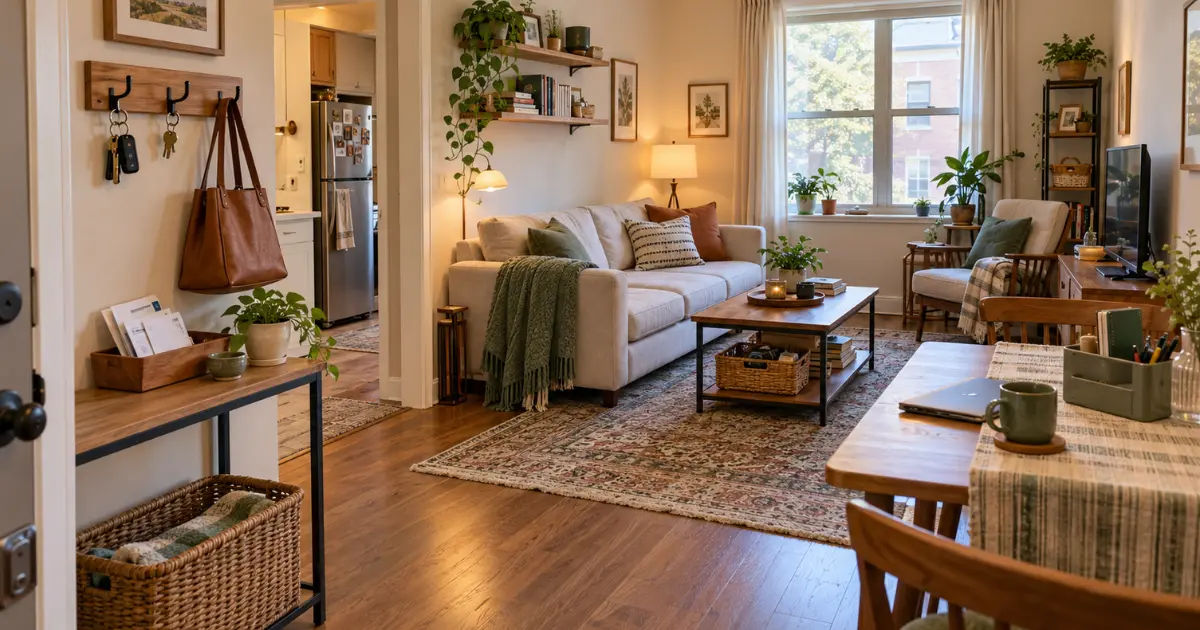
A drop zone gives the belongings that enter and leave with you a predictable landing place. In a small entry, that may be nothing more than a shallow tray on an existing surface, one hook for a frequently used bag, and a small spot for outgoing mail.
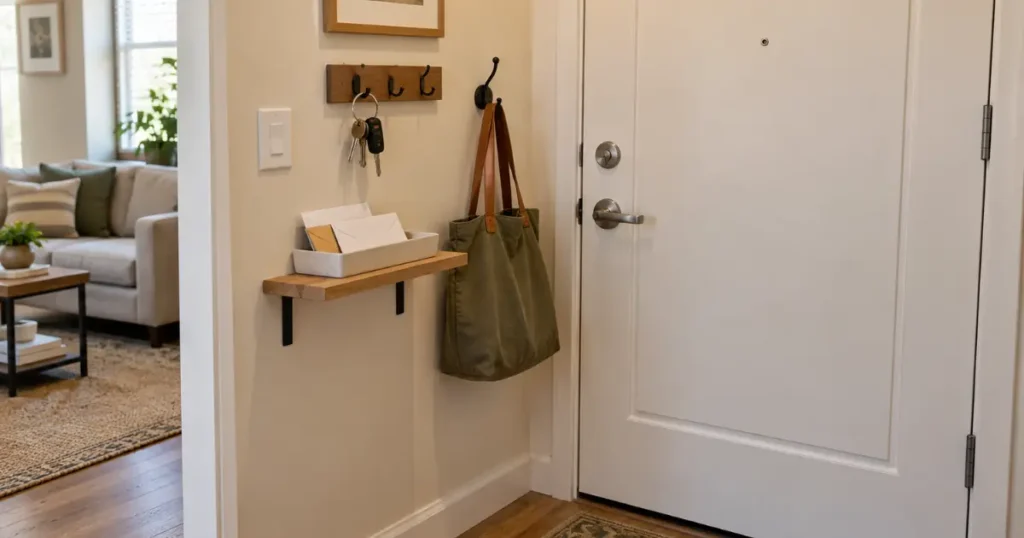
Keep the setup proportional to the entry. If the tray starts collecting receipts, loose change, unopened packages, and unrelated objects, it has stopped functioning as a drop zone and become another catchall. Limit it to items you regularly need when leaving or returning home.
Most importantly, keep the doorway, lock, light switch, and walking route clear. A good entry setup should shorten the routine of coming and going, not make the entrance tighter.
Idea 2: Keep Daily Essentials Together Where You Use Them
Group items that support the same activity so you are not searching in several places every time you sit down to do something.
Near a reading chair, for example, a small tray or drawer might hold reading glasses, a bookmark, and a notebook. Near a place where you handle household paperwork, the useful group might be a pen, envelopes, and the few documents you are actively dealing with.
The organizing principle here is activity-based grouping. The items belong together because you use them together. Keep the group small enough that it remains obvious what belongs there.
Idea 3: Give Frequently Used Items Easy-to-Reach Homes
This idea is about physical access, not grouping. Things you use every day should not require you to move three other objects, kneel down, or reach behind rarely used belongings.
Look at the easiest drawer space, the most accessible shelf level, or the front portion of an existing cabinet. Reserve those locations for high-use items. Less frequently needed belongings can tolerate a less convenient position.
When organizing a small space, ease of return matters just as much as ease of retrieval. If a home’s location is inconvenient, an item is more likely to stay on a counter or chair instead of being put away.
Idea 4: Organize Small Accessories in Shallow Trays
Small objects are easy to lose visually on a larger surface. A shallow tray can give items such as keys, charging cables, pens, remote controls, or grooming accessories a defined boundary without turning the whole surface into storage.
Choose a tray that fits the amount you actually need to contain. A large tray can encourage unrelated items to accumulate, while a tray that is too small simply creates overflow.
This is especially useful on a nightstand, console, desk corner, or inside a drawer. The tray should make small items easier to see and return, not hide a growing pile.
2. Organize Walls, Doors, and Underused Areas
Walls, doors, and overlooked corners can provide useful organization space when floors and surfaces are already crowded. The goal is not to fill every blank wall. It is to create a convenient home for a defined group of belongings while preserving movement and access.
Idea 5: Use the Back of a Door for Lightweight Essentials
The back of a suitable door can hold a few lightweight items without using floor space. Depending on the room, that might mean a slim hanging organizer for scarves, a couple of light accessories, or small everyday supplies.
First check how the door moves. The organizer should not interfere with the handle, latch, hinges, wall, nearby furniture, or the door’s ability to open as intended. Avoid loading a door with heavy objects simply because there is unused vertical area.
If you rent, confirm that the mounting method is allowed. Products described as removable are not guaranteed to behave the same way on every paint, finish, or door surface.
Idea 6: Turn a Narrow Wall Into a Practical Organization Spot
A narrow wall beside an entry, desk, or other activity area can sometimes support a compact hook rail or small wall organizer. The best use is specific: a few dog-walking items near the door, for example, or lightweight supplies beside a workstation.
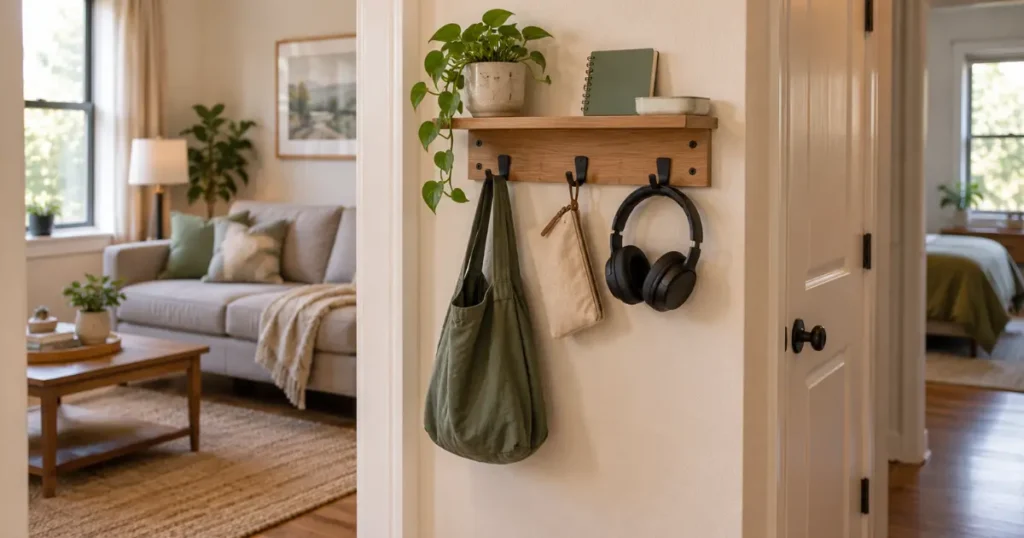
Keep the footprint modest. A wall organizer that projects too far can create a shoulder-level obstacle in a tight passage.
Before mounting anything, consider the wall material, the item’s installation requirements, and the load it is designed to hold. Renters should also check lease terms or ask for permission when necessary rather than assuming a wall attachment is acceptable.
Idea 7: Make Better Use of Awkward Corners
An awkward corner can be useful if it is accessible and solves a real problem. A narrow umbrella stand near an entry or a small basket for workout accessories beside the place they are used may give the corner a clear purpose.
Do not fill a corner that provides turning room, door clearance, or useful breathing space. Use it only when the contents remain easy to reach and the addition does not narrow a daily path.
Idea 8: Use Existing Shelf Height More Effectively
If an existing shelf has a tall empty gap above a short row of belongings, see whether the shelf itself is adjustable or whether a simple freestanding shelf riser would make the space easier to use.
The objective is to use the vertical gap while keeping both levels visible and reachable. This works best for lightweight, stable belongings already assigned to that shelf.
Do not stack so high that reaching the bottom item requires rebuilding the arrangement. Better use of shelf height should improve access, not just capacity.
Idea 9: Keep Small Supplies Together on a Pegboard
A pegboard can work well for a defined group of small supplies that are used often and benefit from being visible. It may suit a compact hobby setup, a small desk zone, or another activity area where tools tend to spread across a surface.
Keep the board focused. A few hooks and small holders for one activity are easier to maintain than a wall covered with unrelated items.
Installation and load limits vary by product and wall type, so follow the manufacturer’s instructions. If mounting is not allowed or appropriate, a freestanding alternative may be better. The goal is convenient access, not turning a wall into a heavy-duty storage system.
3. Make Shared Surfaces and Furniture More Functional
In a compact home, one table or piece of furniture often supports more than one routine. These small space organization ideas focus on keeping those shared areas usable without recreating an entire room around each activity.
Idea 10: Create a Portable Workstation for Shared Tables
If a dining table also becomes a work surface, keep the supplies needed for focused work in one portable setup. A small handled bin, document box, or sturdy caddy might hold a notebook, charger, pens, and the papers needed for the current task.
When work is finished, the entire group can move to one assigned location instead of leaving separate items spread across the table.
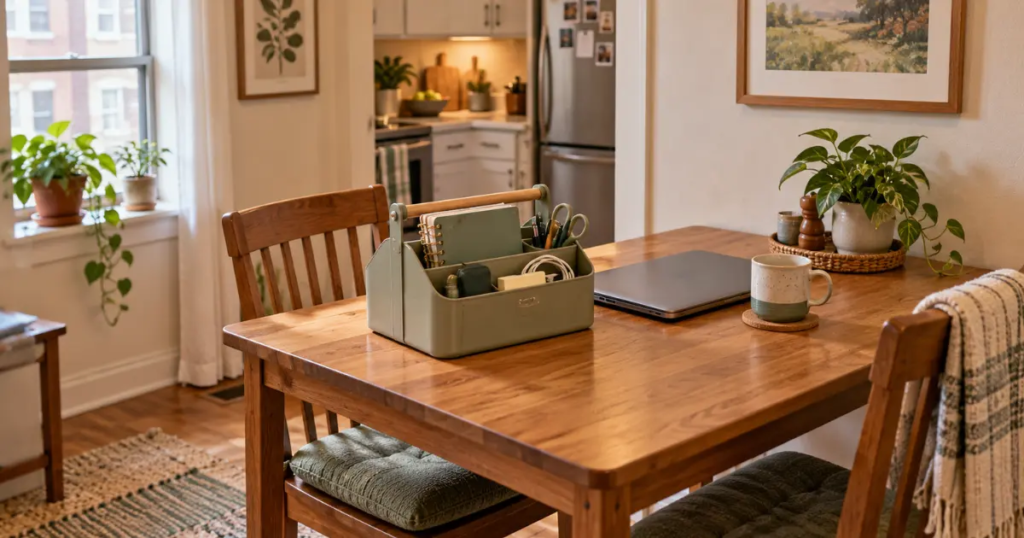
Keep the workstation limited to active essentials. If it becomes a portable filing cabinet for everything work-related, it will be too heavy, too large, or too inconvenient to move.
Idea 11: Organize Everyday Items Inside Existing Furniture
Before adding another organizer to the room, check whether furniture you already use has a drawer or compartment that can take on a clearer purpose.
A side-table drawer, for example, could hold the remote control, charging cable, and small notebook normally left on top. A console drawer near the entry might hold sunglasses and other out-the-door essentials.
Assigning one related category to an existing compartment can reduce surface clutter without increasing the room’s footprint. The key is to avoid turning every drawer into mixed miscellaneous storage.
Idea 12: Use a Rolling Cart for Activities That Move
A modest rolling cart can be useful when one set of supplies genuinely moves between locations. Art materials used at a dining table and then put away elsewhere are one example; another is a small collection of home-office supplies that needs to move out of the way after work.
Choose a cart only if there is a sensible place to park it. Check that its width fits the route it needs to travel and that it does not block a doorway or walkway when stored.
Load it so the cart remains stable, follow any manufacturer guidance, and keep heavier items lower when practical. Mobility is useful only if the cart is easy and safe to move.
Idea 13: Keep Multiuse Surfaces Ready for Their Next Task
A shared surface is easier to reuse when the items that regularly land on it have quick exit routes.
Instead of creating one portable workstation, as in Idea 10, focus here on the surface itself. A table used for meals, bills, and occasional projects might have a nearby drawer for everyday paperwork and one shallow tray for the few objects that need to be cleared together.
Set a limit on what is allowed to remain between activities. The goal is not to keep the surface empty at all times; it is to prevent one task from permanently occupying a space needed for the next one.
4. Use Containers and Existing Storage More Effectively
Containers can make organizing small spaces easier when they clarify categories and improve retrieval. They become less useful when every item is placed inside another layer that must be opened, moved, or remembered.
Idea 14: Divide Deep Drawers Into Usable Sections
Deep drawers often become mixed piles because small items slide, stack, and disappear behind one another. Simple dividers or smaller boxes inside the drawer can create sections for categories that would otherwise blend together.
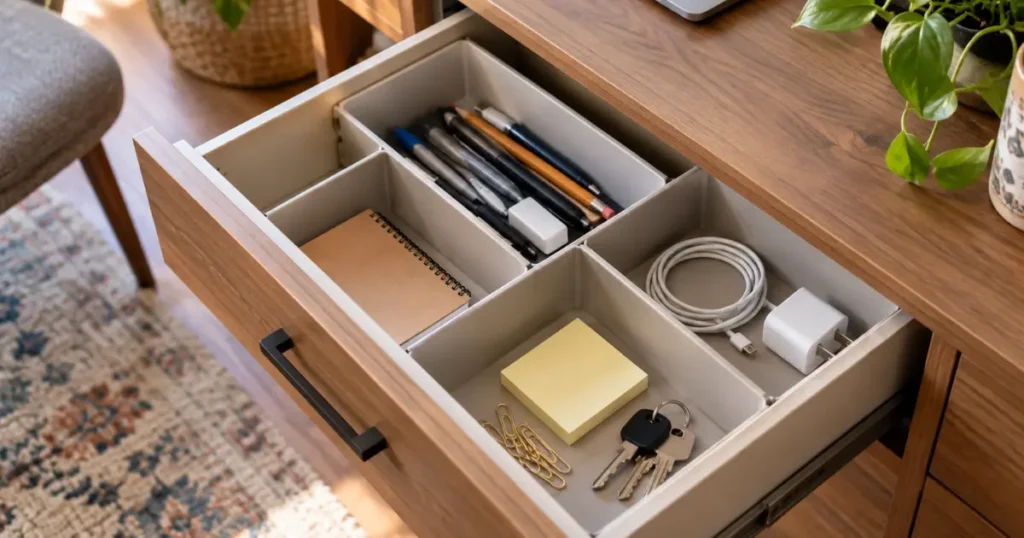
Measure the drawer before adding anything, and match the sections to the belongings rather than forcing belongings into arbitrary compartments.
Leave enough room to lift items out comfortably. A tightly packed drawer with perfect divisions can still be frustrating if one object has to be removed before another can be reached.
Idea 15: Group Similar Items in Clearly Defined Containers
Use a container when it helps create a clear category boundary. One box might hold basic mailing supplies; another might hold spare charging cables. The container communicates what belongs together and where the category stops.
This is different from simply hiding miscellaneous objects. If the contents do not share a useful purpose, the box will become a harder-to-see junk pile.
Choose a size that reflects the amount you reasonably want to keep. A defined boundary can make it easier to notice when a category has expanded beyond the space assigned to it.
Idea 16: Make Frequently Used Items Visible and Accessible
Some belongings are easier to manage when you can see what is available. That might mean placing everyday household supplies at the front of an existing cabinet, using an open-top bin inside a shelf, or keeping frequently used paperwork upright rather than buried in a stack.
Visibility does not mean everything needs to be displayed. Private or infrequently used items can remain behind doors or inside drawers. If seeing a category creates more visual clutter than practical benefit, use an easy-to-open contained option instead.
Idea 17: Use Baskets to Contain Small, Related Belongings
A basket is useful when a loose category needs a movable physical boundary. A small basket beside a sofa might hold a frequently used throw blanket and one or two reading items; another might hold a compact group of workout accessories near the place they are used.
Unlike Idea 15, which is about defining categories within storage, this idea uses the basket itself as a practical, portable containment tool.
Keep the category specific and the basket easy to lift. Oversized baskets can become deep catchalls where small items disappear, so choose a size that lets you see and handle the contents without digging.
5. Try Budget-Friendly and Simple DIY Organization Ideas
Useful organizing does not always require buying a coordinated set of products. Cheap organization ideas for small spaces often come from adapting ordinary items to solve a narrow problem. DIY organization ideas for small spaces work best when the project stays simple, stable, and easy to undo if it does not help.
Idea 18: Repurpose Containers You Already Own
Before buying a new bin, look for clean, sturdy containers you already have that match the job. A small gift box can separate stationery inside a drawer. A clean glass jar can hold pens on a desk. A rigid shoebox can group light backup supplies on a shelf.
Use common sense about the material and contents. Avoid damaged containers, sharp edges, unstable stacks, or reusing packaging in ways that could confuse household chemicals, food, or other sensitive items.
Repurposing works best when the container fits an actual category. Keeping random packaging “just in case” can create more clutter than it prevents.
Idea 19: Make a Simple Desk Supply Organizer
A basic desk organizer can be made from small sturdy boxes or clean cardboard containers placed together inside a shallow tray or larger box. Use separate sections for pens, sticky notes, clips, and a few other supplies you regularly reach for.
You do not need elaborate cutting or construction. The value comes from giving small items consistent positions so they do not scatter across the work surface.
Make sure any cut edges are smooth and the finished organizer sits flat. If the DIY version feels flimsy or constantly tips, simplify it rather than adding more pieces.
Idea 20: Create a Low-Cost Organization Station for Hobbies
Choose one modest hobby and gather the supplies used most often into a compact station. For sketching, that might be one box for pencils and erasers, a folder for paper, and a small caddy that can move to the table when needed.
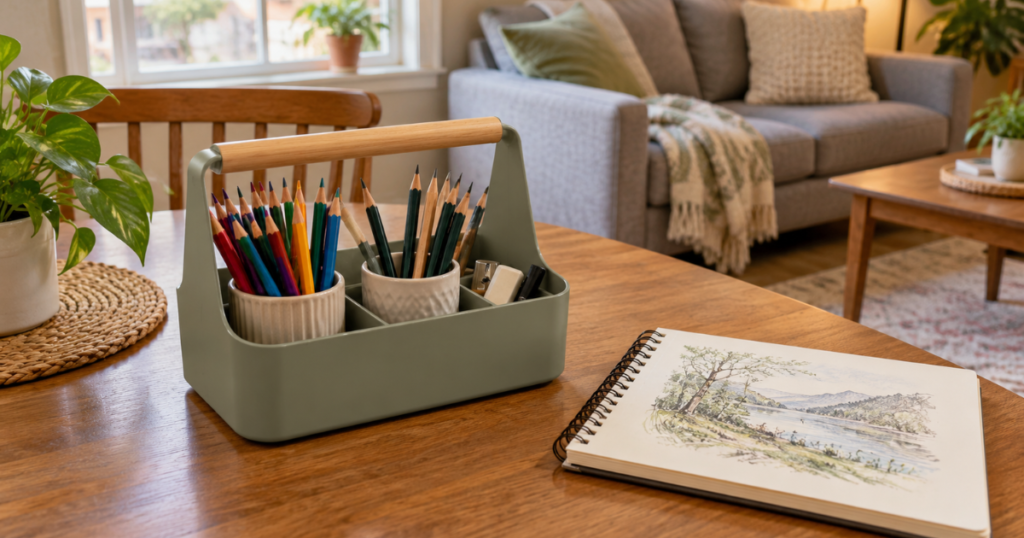
Keep the station sized to the hobby as you actually practice it. Specialty or seldom-used supplies can live elsewhere if including them would make the everyday setup bulky.
This gives hobby supplies a designated home without letting them spread across several surfaces.
Idea 21: Adapt an Existing Shelf for More Useful Organization
An existing shelf can become more useful when you assign it a specific purpose rather than simply adding more belongings to it. For example, a shelf near the entry could become an outgoing-items station with a shallow tray for returns, a vertical file for papers that need to leave the home, and one small space for a reusable bag.
You can often create this structure with items already on hand, such as a bookend, a sturdy box, or a repurposed file holder.
Keep the adaptation reversible unless you know the shelf material, installation, and modification are suitable. The goal is to make one shelf support a specific routine, not permanently alter furniture without a clear reason.
6. How to Choose the Right Ideas for Your Space
You do not need all 21 suggestions. The right small space organization ideas depend on the problem you are solving and the physical limits of your home.
If you’re organizing an entire apartment and need a clear starting point before choosing individual solutions, our guide on how to organize a small apartment explains the process step by step.
Start by identifying one repeated frustration: lost entry items, a table that never clears, a drawer that mixes categories, or supplies that migrate from room to room. Then compare possible solutions against a few practical questions:
- Does it fit the available width, depth, height, and clearance?
- Can the people who need it reach and use it comfortably?
- Does it solve the problem with fewer steps rather than more?
- Is the cost reasonable for the benefit?
- If you rent, is the installation or modification permitted?
- Does it work for children, pets, mobility needs, or other household realities?
- Can it be maintained without constant rearranging?
- Does it preserve clear doorways and walking routes?
For tall freestanding shelves or cabinets, stability and tip-over prevention also matter. Follow the manufacturer’s safety and anchoring instructions rather than assuming a narrow footprint is automatically safe.
In homes with children, furniture tip-over prevention deserves particular attention. The U.S. Consumer Product Safety Commission provides furniture tip-over safety guidance on securing furniture and following manufacturer instructions.
If you want a complete organization sequence instead of individual ideas, see our guide on how to organize small spaces.
For broader guidance on comfort, furniture flow, and making a compact home work day to day, our small space living guide covers that wider topic.
Editorial internal-link placeholder: Activate small space living only after PS-02 is live and its final URL has been verified.
7. Common Small Space Organization Mistakes
Even practical organization ideas can make a compact home harder to use if they add obstacles or too many steps.
- Buying organizers before identifying the problem. A container is useful only when you know what it needs to hold, where it will go, and how it will improve access.
- Blocking doors or walking routes. A new hook, cart, basket, or shelf is not an improvement if it narrows a route you depend on or interferes with a door or window.
- Overloading shelves or wall organizers. More vertical capacity is not a reason to exceed the product’s load guidance or use an installation method that does not suit the surface.
- Using too many separate containers. Too many separate containers can create extra lids, labels, and unnecessary steps. Use the fewest boundaries needed to keep categories understandable.
- Choosing arrangements that are difficult to maintain. If putting something away requires several moves, the system may look organized but fail in ordinary use.
- Filling every available surface. Some clear area is necessary for daily tasks and makes it easier to notice when something is out of place.
The most effective small space organization ideas remove friction. They do not simply make the room hold more.
8. Frequently Asked Questions About Small Space Organization Ideas
Q: What are the easiest small space organization ideas to try first?
A: Start with a problem that happens every day. A small entry drop zone, a tray for loose accessories, a better home for high-use items, or a portable work caddy can usually be tried without changing the room. Choose the idea that eliminates a repeated search, pile, or cleanup step.
Q: How can I organize a small space without buying new furniture?
A: Reassign drawers and shelves you already have, group related items at their point of use, repurpose suitable containers, and improve the way existing shelf space is arranged. Organizing a small space often works better when you improve access before adding another piece of furniture.
Q: What are some cheap organization ideas for small spaces?
A: Repurpose clean boxes or jars, use a shallow tray to contain small items, turn an existing drawer into a defined category, or create a simple hobby or work caddy from containers you already own. Low cost is most useful when the solution addresses a specific problem rather than adding more objects.
Q: How can renters organize small spaces without drilling?
A: Focus first on freestanding and in-furniture solutions: trays, drawer dividers, portable caddies, baskets, adjustable existing shelves, or a rolling cart where there is safe clearance. If you consider an adhesive or over-the-door product, check the manufacturer’s instructions, door clearance, surface compatibility, and your lease rather than assuming it will be damage-free or permitted.
9. Final Thoughts
The strongest small space organization ideas are usually the ones that solve a real daily frustration with the least added complexity. A useful tray, a more accessible shelf, a portable workstation, or one clearly defined container can make more difference than a large collection of organizers.
Choose one or two ideas that match your available space, routines, budget, and rental limits. Try them long enough to see whether they make belongings easier to find, use, and put away. If they do, keep them. If they create extra steps or new clutter, simplify the system and try a better fit.